Quick Links
- Why Do Traditional Enterprise AI Pilots Often Fail?
- What Is a 48-Hour Proof of Value (POV) Framework?
- How One Automotive Dealership Validated AI Value in 48 Hours
- How a Global Testing and Certification Organization Validated Multiple AI Use Cases in Weeks Instead of Months
- How Pre-Built Connectors Accelerate Enterprise AI Deployments
- Why Enterprises Are Prioritizing Proof of Value Before Large AI Investments
- Why Proof of Value Is Becoming the New Enterprise AI Playbook
- FAQs
Proof of Value in 48 Hours: Why Enterprise AI Projects Are Moving Beyond Traditional Pilots

Key Takeaways
- Traditional enterprise AI pilots often fail because they are too broad, take too long, and focus on demonstrating capabilities rather than business outcomes.
- A 48-hour Proof of Value (POV) helps organizations validate a specific AI use case using real data, clear success criteria, and measurable results.
- Pre-built integrations with enterprise systems such as CRM, ERP, and document platforms significantly reduce implementation time.
- Rapid validation enables enterprise leaders to reduce risk, build stakeholder confidence, and make faster investment decisions.
- The organizations seeing the greatest success with AI are prioritizing proof of business value before scaling enterprise-wide adoption.
One of the most common things I hear in conversations with enterprise leaders is this:
"We don't want another AI pilot."
Not because organizations have lost interest in AI. Quite the opposite.
Many enterprises have already spent months evaluating platforms, attending demos, running workshops, and exploring potential use cases. The challenge is that too many AI initiatives get stuck between experimentation and deployment. By the time a traditional pilot concludes, priorities have shifted, budgets have changed, and momentum has faded.
What I've noticed is that the organizations making the most progress with AI today are approaching validation very differently.
Instead of running six-month pilots designed to showcase capabilities, they are focusing on proving business value as quickly as possible. They are narrowing the scope, using real enterprise data, defining success upfront, and looking for measurable outcomes within days rather than months.
This isn't about cutting corners. It's about recognizing that the reason many enterprise AI pilots fail is rarely technical. More often, they become too broad, run too long, involve the wrong stakeholders, and focus on demonstrating what the technology can do instead of proving what it can deliver.
As a result, many enterprise AI initiatives are converging around a new approach: focused, time-boxed Proof of Value engagements that establish measurable impact in 48 to 72 hours.
The organizations seeing the fastest AI adoption are not necessarily the ones running the largest pilots. They are the ones proving value quickly, building confidence early, and scaling from demonstrated business outcomes.
Why Do Traditional Enterprise AI Pilots Often Fail?
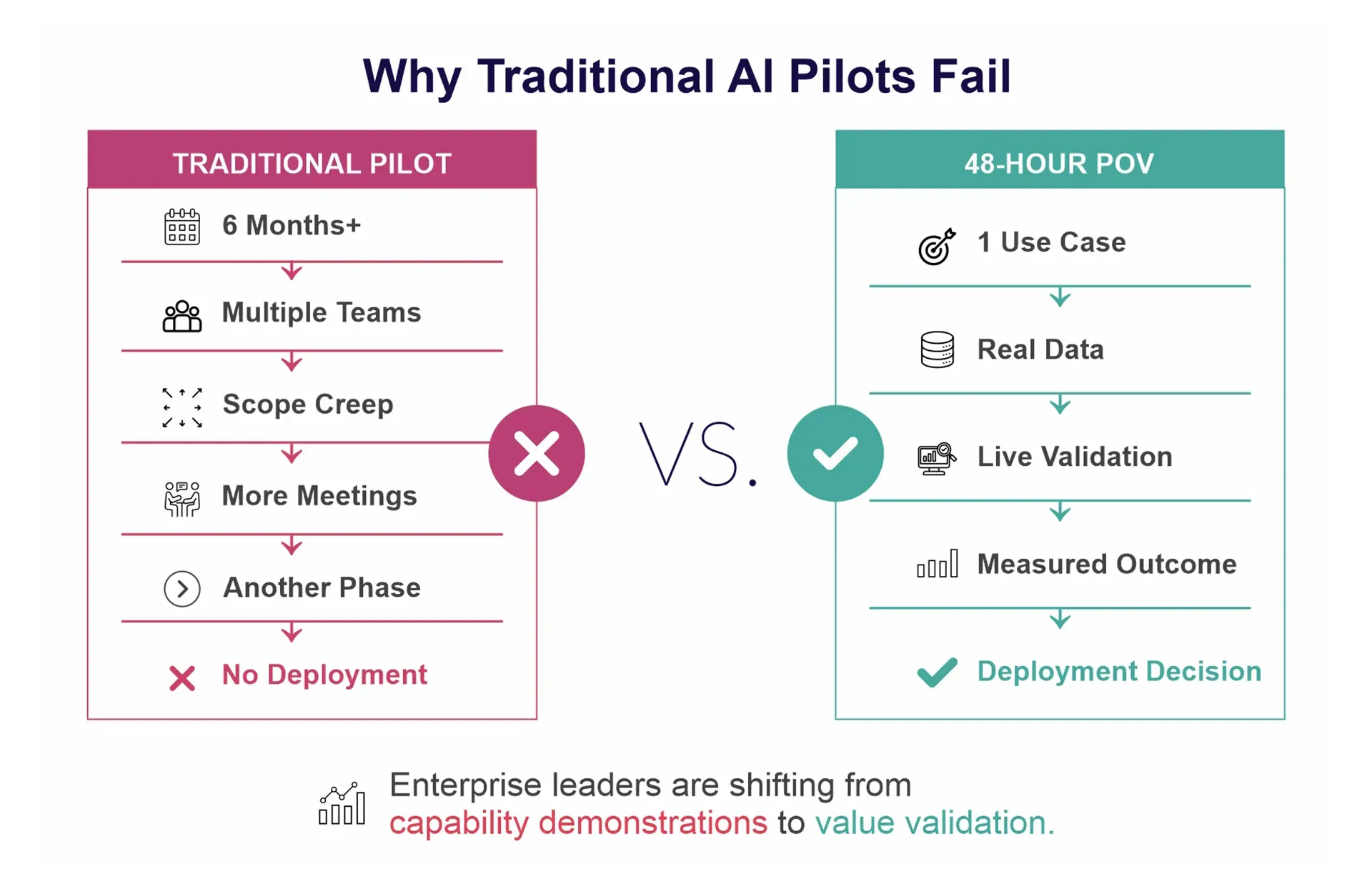
In many of my conversations with enterprise leaders, I’ve noticed a recurring pattern. Organizations invest significant time and effort into AI pilots, yet relatively few of those pilots ever evolve into large-scale deployments.
The traditional enterprise AI pilot often follows a familiar path. A use case is selected, a vendor is brought in, a project team is assembled, and a multi-month timeline is established. Several months later, the organization has a working demonstration but still lacks a clear answer to a much more important question:
What measurable business value did we actually create?
The challenge is rarely the technology itself. More often, it comes down to how the pilot was designed and executed.
Across industries, the same issues tend to surface repeatedly:
- Scope creep: Pilots gradually expand to include additional use cases before the original problem has been validated.
- Wrong stakeholders: Technical teams evaluate the solution, while the business teams responsible for outcomes remain disconnected from the process.
- Wrong metrics: Success is measured by whether the AI works, rather than whether it solves a meaningful business problem.
- Wrong timelines: Long pilot cycles create opportunities for priorities to shift, budgets to change, and project momentum to disappear.
The result is often a pilot that successfully demonstrates capability but fails to build enough confidence for a production deployment. Instead of moving forward, organizations find themselves discussing a second phase, another workshop, or an extended evaluation cycle.
What I’ve found is that enterprises are becoming increasingly frustrated with this approach. Leaders want faster validation, clearer outcomes, and stronger alignment between technology investments and business objectives.
That shift is one of the key reasons why Proof of Value models are gaining momentum. Instead of spending months proving that AI can work, organizations are focusing on proving that it can deliver measurable results.
What Is a 48-Hour Proof of Value (POV) Framework?
Many enterprise AI deployments today are moving away from lengthy pilots and toward focused Proof of Value (POV) engagements that demonstrate business value in days rather than months.
A successful POV is built around four principles:
Narrow Scope
Focus on one workflow, one dataset, and one clearly defined business problem. The goal is not to evaluate an entire platform, but to prove value for a specific use case.
Real Data
The solution works against the client's actual data, within their environment, and connected to their existing systems. This allows leaders to evaluate AI in a real operational context rather than through a curated demo.
Defined Success Criteria
Success is measured using business outcomes, not technical metrics.
For example:
"Can a sales representative generate a compliant quote in under five minutes instead of forty-five?"
Clear outcomes make it easier for stakeholders to evaluate impact and make decisions.
Compressed Timeline
Most POV engagements are completed within 48 to 72 hours, creating enough time to build something meaningful while maintaining focus and momentum.
This speed is often made possible by pre-built integrations with platforms such as Salesforce, SAP, NetSuite, and SharePoint, allowing teams to spend less time building infrastructure and more time validating business value.
As I shared during one discussion on enterprise AI deployments:
"We built a working automotive dealership command center prototype in 48 hours. It connected CRM, finance, and service data. The client made a deployment decision on the spot."
— Jayant Umrani, CEO — Bolt Today
How One Automotive Dealership Validated AI Value in 48 Hours
One of the most compelling examples of the Proof of Value approach came from an engagement with an automotive dealership group.
The challenge was straightforward. General managers lacked a unified view of daily business performance. Sales data lived in one system, finance data in another, and service operations in a third. Getting a complete picture required manually pulling information from multiple sources, a process that was both time-consuming and difficult to maintain in real time.
The objective of the POV was intentionally narrow:
Create a single command center that allowed a general manager to view real-time performance across sales, finance, and service operations from one place, while also providing the ability to drill into specific issues when needed.
Rather than spending months designing a future-state solution, the focus was on proving whether the concept could deliver meaningful operational value.
The result was a working prototype connected to live business data in just 48 hours.
By the second day, the general manager was already using the command center to review operational performance and quickly identified a service backlog pattern that had previously gone unnoticed in existing reports.
What stood out was not the speed of the build itself. It was the speed at which the business value became visible.
The deployment discussion began in the same meeting where the solution was demonstrated.
That outcome highlights an important shift in how enterprises are approaching AI adoption today. When organizations can validate value against a real business problem using real data, decision-making becomes significantly easier.
The conversation moves away from what the technology might do in the future and focuses instead on what it is already delivering today.
How a Global Testing and Certification Organization Validated Multiple AI Use Cases in Weeks Instead of Months
For a global testing, inspection, and certification organization, the challenge was more complex. The team wanted to explore how AI could improve access to contract information while supporting compliance-related workflows.
From the initial discovery conversation to a live workshop, the entire Proof of Value engagement was completed in under three weeks. During the two-day workshop, the client team worked directly with their own data and systems to validate real-world use cases.
By the end of the workshop, three key use cases had been successfully validated:
- Contract document search and information extraction.
- KYC compliance assistance.
- Natural language access to enterprise data through an AI assistant.
As one post-workshop discussion highlighted:
"The workshop structure agreed was exactly right. Initial demo on day one to orient the team, then hands-on build sessions where their own technical people were driving. That's how you get real validation — not a vendor demo."
— From a post-workshop debrief on the client's POV engagement, 2026
What made the engagement successful was the ability to test real use cases against real data and validate business value before making broader deployment decisions.
How Pre-Built Connectors Accelerate Enterprise AI Deployments
One of the biggest reasons enterprise AI projects take months to deliver value is integration.
Much of the timeline is often spent connecting systems, mapping data, and resolving technical dependencies before a business use case can even be tested.
Pre-built connectors help eliminate much of that effort. When integrations for platforms such as Salesforce, SAP, NetSuite, and SharePoint already exist, connecting to enterprise systems becomes significantly faster.
This allows organizations to spend less time building infrastructure and more time validating outcomes.
Instead of waiting months to determine whether a use case delivers value, teams can begin testing and measuring results almost immediately.
More importantly, faster integrations change how enterprises approach AI adoption. When the time and effort required to explore a use case are dramatically reduced, organizations can validate ideas faster, make decisions with greater confidence, and move successful initiatives into production more quickly.
That ability to compress implementation timelines is one of the key reasons enterprise AI projects are increasingly shifting from multi-month evaluations to Proof of Value engagements measured in days.
Why Enterprises Are Prioritizing Proof of Value Before Large AI Investments
Another trend that surfaced repeatedly in conversations with enterprise leaders is a shift in how organizations evaluate AI investments.
Traditionally, enterprises often approved large projects based on projected outcomes, with the expectation that value would emerge over time.
Today, many leaders are taking a different approach. Before making significant investments, they want to validate value using their own data, workflows, and success criteria.
This is where the Proof of Value model becomes valuable.
Instead of spending months evaluating potential benefits, organizations can test a focused use case, measure results, and determine whether broader deployment makes sense. By the time commercial discussions begin, stakeholders already have a clearer understanding of the business impact.
More importantly, the conversation shifts from assumptions to evidence. Teams can evaluate real outcomes within their own operational environment rather than relying on projections.
What became clear across these discussions is that enterprises are becoming more disciplined about AI adoption. Demonstrating value early is no longer a nice-to-have—it is increasingly becoming a prerequisite for large-scale AI investment.
The organizations moving fastest with AI are not necessarily the ones making the biggest upfront commitments. They are the ones validating value quickly and scaling with confidence.
Why Proof of Value Is Becoming the New Enterprise AI Playbook
Across many conversations with enterprise leaders, one trend continues to stand out: organizations are becoming less interested in lengthy pilots and more focused on proving business value quickly.
Enterprise AI projects rarely fail because the technology doesn't work. More often, they fail because the path from experimentation to measurable business impact is too long and difficult to justify.
That's why leading organizations are taking a different approach. Instead of evaluating broad platform capabilities, they are validating specific business outcomes using real data, focused use cases, and clearly defined success criteria.
The examples in this blog reflect that shift. Whether it was an automotive dealership validating a command center in 48 hours or a global testing and certification organization validating multiple AI use cases against its own data, the common factor was rapid validation of business value.
What stood out most to me is that enterprises are no longer asking:
"Can AI do this?"
They're asking:
"Can AI deliver measurable business value quickly enough to justify broader adoption?"
And increasingly, the answer is being determined through focused Proof of Value engagements rather than lengthy pilot programs.
At Bolt Today, we've seen how rapid Proof of Value engagements help organizations move from AI experimentation to measurable outcomes faster. If you're evaluating enterprise AI initiatives and want to validate impact before making large-scale investments, we'd be happy to explore what that could look like for your business.
The 48-hour Proof of Value is not a shortcut. It's a disciplined approach to proving what matters most: business value.
FAQs
A Proof of Value (POV) is a focused engagement that validates a specific AI use case using real business data, defined success criteria, and measurable outcomes before larger investments are made.
Traditional pilots often take months and focus on demonstrating capabilities. A POV focuses on proving business value for a specific use case, typically within 48 to 72 hours.
Organizations want faster validation, lower risk, and clearer ROI. A POV helps stakeholders evaluate real outcomes before committing to broader AI initiatives.
Workflow automation, reporting and dashboards, AI assistants, contract intelligence, compliance workflows, and cross-system data visibility are common starting points.
Pre-built connectors for platforms such as Salesforce, SAP, NetSuite, and SharePoint reduce integration effort, allowing teams to focus on validating business outcomes instead of building infrastructure.
Success is typically measured through business outcomes such as reduced processing time, improved productivity, faster decision-making, or increased operational visibility.