Quick Links
- Why Are Enterprise AI Costs Becoming So Difficult to Manage?
- What Is SaaS Chaos in Enterprise AI?
- Why Are Enterprises Moving Away From Per-Seat AI Pricing?
- What Do Enterprises Actually Want From AI Platforms?
- Why Are Enterprises Shifting From AI Licenses to AI Outcomes?
- How Should Enterprises Evaluate AI Platforms in 2026?
- To Conclude
- FAQs: About Enterprise AI Costs and Scalability
The $3,500-Per-User Problem: Why Enterprise AI Is Bankrupting the Business Case

Key Takeaways
- Enterprises are struggling with rising AI licensing and token consumption costs.
- Managing 20–25 disconnected AI tools is creating operational complexity and governance challenges.
- Enterprise leaders increasingly prefer private AI deployments over public AI dependencies.
- Businesses are shifting from per-seat licensing models toward outcome-based AI investments.
- AI adoption is accelerating fastest in operational workflows tied to measurable business value.
- Rapid proof-of-value deployments are reshaping enterprise buying expectations.
Somewhere between the fifth and sixth AI tool an enterprise added this quarter, something quietly broke.
Not because the tools failed individually. Most of them worked exactly as promised. The problem was that organizations were no longer building intelligence into the business. They were building another layer of operational complexity on top of systems that were already fragmented.
Over the last year, I’ve had conversations with enterprise leaders across healthcare, manufacturing, telecom, automotive, RevOps, and professional services who all described remarkably similar challenges. What began as isolated AI experiments quickly turned into overlapping licenses, disconnected workflows, rising operational costs, and teams struggling to manage an increasingly fragmented AI stack.
At first, most organizations viewed these tools as productivity accelerators. But as adoption expanded across departments, many leaders realized they weren’t creating a unified intelligence layer across the enterprise. They were adding more platforms, more vendors, more interfaces, and more governance challenges to environments that were already difficult to manage.
Here’s the math very few vendors openly discuss:
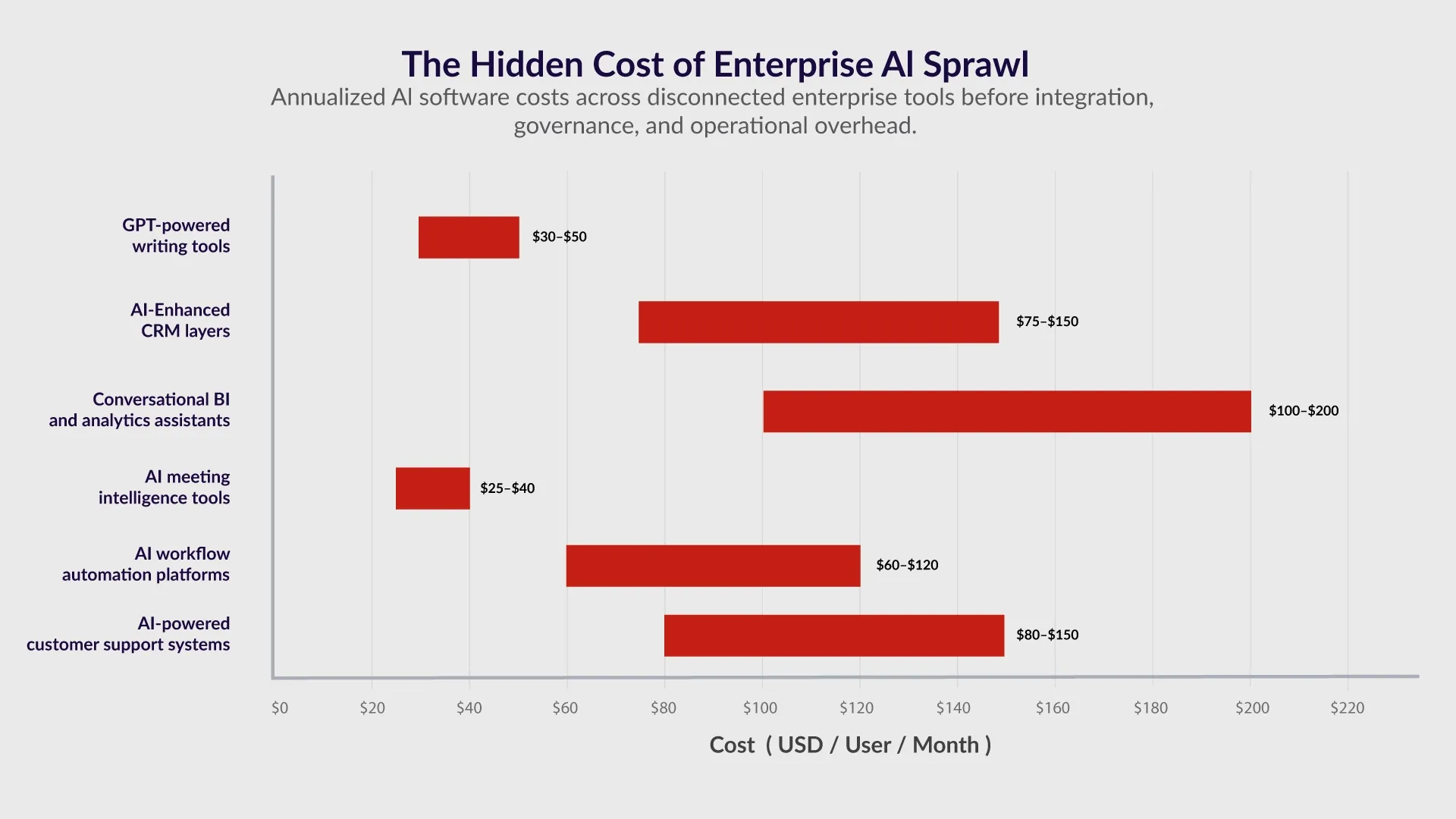
Across a mid-sized enterprise team, those numbers scale quickly. Add enterprise licensing tiers, implementation costs, integration overhead, token consumption fees, and growing AI usage across departments, and organizations can easily find themselves spending thousands of dollars per user annually across disconnected AI systems.
In several enterprise discussions I participated in, leaders described environments where teams were already managing 20–25 different SaaS products while simultaneously trying to reduce operational complexity and licensing costs. One recurring concern was that AI spending was growing significantly faster than measurable operational outcomes.
As I mentioned during one advisory session with enterprise technology leaders earlier this year:
“Enterprises are drowning in per-seat AI charges across 20 to 25 SaaS tools, with no unified outcome to show for it — and the buying mindset is shifting fast.”
— Jayant Umrani, from an advisory session with enterprise technology leaders, 2026
Why Are Enterprise AI Costs Becoming So Difficult to Manage?
The fragmentation many enterprises are experiencing is an architectural issue, rather than just a budget issue.
Most AI products today are designed to solve isolated functional problems. The AI writing assistant operates independently from the CRM layer. The analytics assistant does not share operational context with the meeting intelligence platform. Workflow automations often sit separately from reporting systems and forecasting environments.
Instead of creating a connected intelligence layer across the business, organizations often end up with disconnected AI systems producing fragmented outputs across departments.
I’ve had conversations with CIOs and operational leaders across healthcare, manufacturing, financial services, telecom, and legal technology who described remarkably similar situations. The tools often look impressive during demonstrations. But once deployed into production environments, teams are forced to spend significant time reconciling outputs, managing integrations, validating data consistency, and governing workflows across systems that were never designed to work together cohesively.
That operational friction becomes its own hidden cost.
What Is SaaS Chaos in Enterprise AI?
One phrase kept appearing repeatedly in enterprise AI conversations: SaaS chaos.
It describes what happens when departments begin independently purchasing AI tools to solve localized operational problems.
Sales teams adopt AI prospecting assistants. Marketing teams invest in AI content platforms. Finance teams purchase AI forecasting tools. IT departments deploy monitoring copilots. Each purchase appears reasonable on its own. But over time, organizations inherit a fragmented AI ecosystem with overlapping capabilities, disconnected workflows, inconsistent governance, and mounting operational overhead.
The hidden cost is not limited to licensing. Enterprises also absorb the complexity of:
- onboarding teams onto multiple systems
- managing separate permission structures
- conducting repeated security reviews
- handling integration conflicts
- retraining employees as platforms evolve
- and maintaining fragmented operational workflows
During one strategic roundtable session, a CIO from an enterprise software company summarized the issue clearly:
“We had 23 AI tools in our stack. When I asked my team what outcomes we could directly attribute to each one, they could answer for maybe four.”
— CIO, enterprise software firm — from a strategic roundtable session, 2026
That statement reflects a broader enterprise concern I kept hearing repeatedly: businesses do not want more AI tools. They want operational intelligence across the systems they already use.
Why Are Enterprises Moving Away From Per-Seat AI Pricing?
Enterprises are moving away from per-seat AI pricing because AI value scales across shared workflows and organizational data rather than individual users. Many businesses now prefer pooled or consumption-based pricing models that reduce licensing complexity and operational costs.
Traditional software licensing models were designed around individual productivity tools. A CRM license was assigned to a salesperson. A design platform license belonged to a creative team member. The value scaled roughly alongside the number of users.
AI behaves differently.
The value of enterprise AI compounds across workflows, operational context, and shared organizational data — not simply through headcount expansion. A well-architected AI layer serving 1,000 users does not necessarily cost ten times more to operate than one serving 100 users.
That is why many enterprise leaders are beginning to question whether per-seat AI pricing models are fundamentally aligned with long-term enterprise adoption.
In several discussions, leaders expressed frustration that AI licensing structures still resemble legacy SaaS models even though the underlying operational value comes from shared intelligence across the business.
One recurring question from enterprise buyers was simple:
“Why should AI access scale like traditional software licenses when the underlying data and workflows are shared across the business?”
— Jayant Umrani, CEO — Bolt Today
The organizations gaining the most traction with AI today are increasingly focusing less on buying more seats and more on building scalable intelligence infrastructure.
What Do Enterprises Actually Want From AI Platforms?
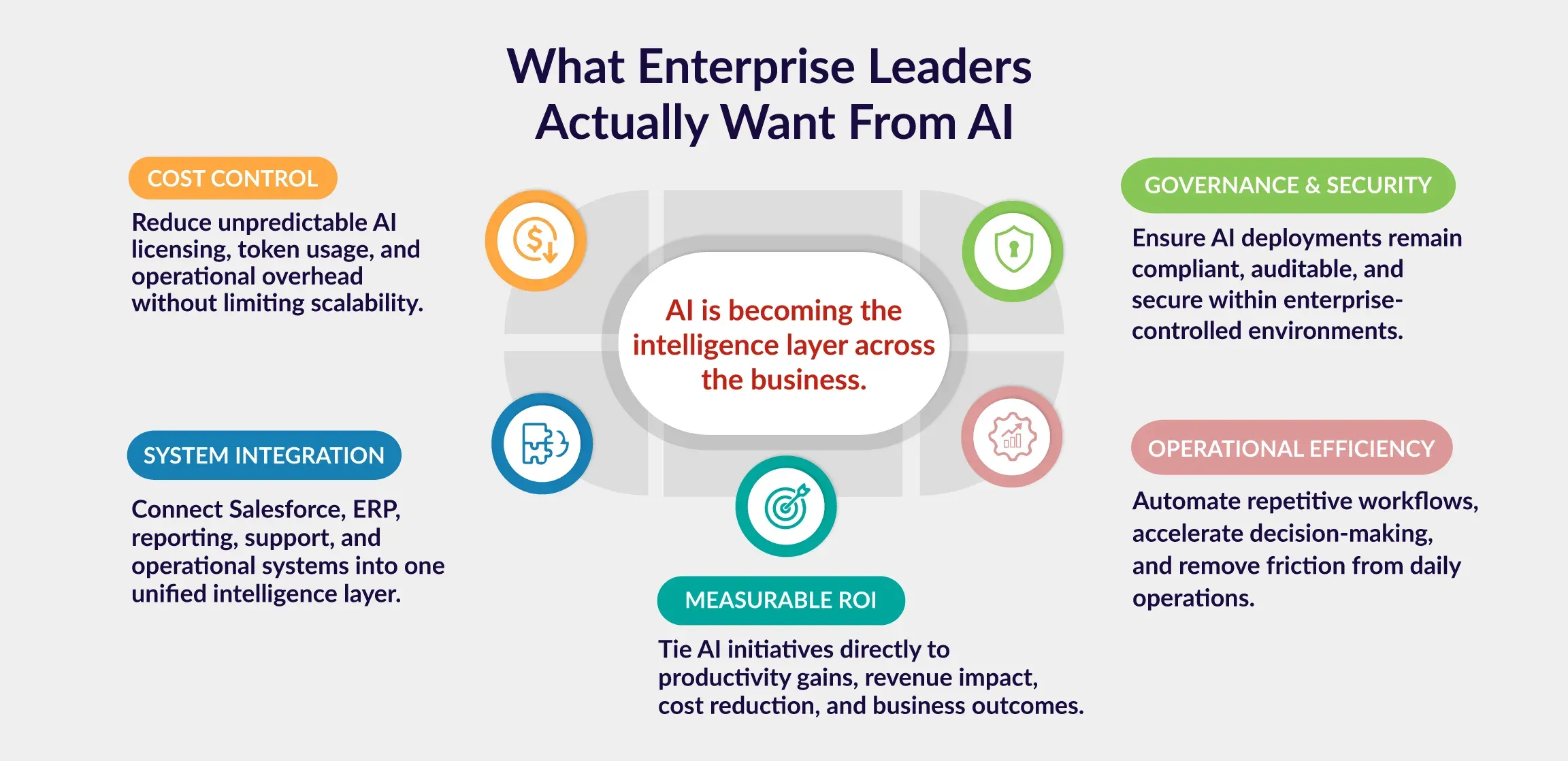
The conversations I’m having with enterprise buyers in 2026 have shifted significantly. Three priorities now surface consistently across industries:
1. Private, pooled, consumption-based pricing
Organizations increasingly want AI pricing models tied to usage and outcomes rather than per-user licensing structures. Many leaders discussed the need for shared AI infrastructure that supports broad organizational access without exponentially increasing licensing costs.
2. Data sovereignty and private deployments
Security and governance concerns surfaced in nearly every enterprise discussion. Businesses want AI operating within their own cloud environments, under their own governance policies, without exposing sensitive operational data externally. This is especially critical in regulated industries like healthcare, finance, and manufacturing where compliance and data ownership requirements are non-negotiable.
3. Unified governance
Leaders also emphasized the need for centralized AI governance models that control:
- data access
- permissions
- operational visibility
- AI behavior
- and compliance oversight
Enterprises do not want to manage governance separately across dozens of disconnected AI platforms.
Why Are Enterprises Shifting From AI Licenses to AI Outcomes?
Underneath all these discussions is a much larger shift in enterprise buying behavior.
Organizations are moving away from purchasing AI access based on licenses and moving toward evaluating AI based on measurable operational outcomes.
Instead of committing to long enterprise contracts upfront, buyers increasingly want fast proof-of-value cycles tied directly to real operational workflows and enterprise data. Several leaders I spoke with mentioned expectations for working proofs-of-concept within days — not months.
That expectation is reshaping enterprise software sales itself.
Rather than relying on abstract demonstrations or long implementation roadmaps, enterprises now expect vendors to quickly validate:
- operational efficiency gains
- automation opportunities
- reporting improvements
- workflow acceleration
- and measurable ROI
The pooled, credit-based AI pricing discussions I encountered during these conversations emerged directly from this broader shift toward operational outcomes rather than traditional licensing models.
How Should Enterprises Evaluate AI Platforms in 2026?
If you are currently evaluating enterprise AI platforms — or preparing to justify future AI spending internally — there are several questions worth asking before making long-term commitments.
Question 1: Does the pricing model reward consolidation or penalize it?
If costs increase every time you unify more workflows and users into the platform, the incentives may already be misaligned with your long-term operational goals.
Question 2: Where does your data actually go?
Many enterprises are now carefully evaluating:
- deployment architecture
- data retention policies
- vendor access permissions
- model training exposure
- and compliance structures
Private deployment matters far more than marketing terminology.
Question 3: Can the vendor demonstrate measurable value quickly?
The strongest enterprise AI platforms should be able to validate operational impact against real workflows and enterprise data within a compressed timeframe — not after months of implementation effort.
What This Means for Enterprise Leaders
- Prioritize unified AI layers
- Avoid fragmented AI ecosystems
- Validate ROI quickly
- Focus on governance early
- Scale AI operationally, not experimentally
To Conclude
The $3,500-per-user problem is not going away on its own. In many organizations, it compounds with every new AI tool added without a unifying architecture beneath it.
The enterprises that solve this challenge first will not simply reduce costs. They will build a long-term operational intelligence advantage over organizations still trying to manage fragmented subscriptions, disconnected workflows, and siloed AI systems.
The bigger opportunity is not adding more AI products. It is building connected intelligence across the systems businesses already rely on every day.
At Bolt Today, we are actively working with enterprise teams to help simplify AI adoption through secure, scalable, and operationally practical AI architectures that integrate with existing business systems instead of adding more complexity.
Because the future of enterprise AI will not belong to organizations with the most tools.
It will belong to organizations with the most connected intelligence.
FAQs: About Enterprise AI Costs and Scalability
Enterprise AI costs are rising due to per-seat licensing, token consumption fees, multiple disconnected AI tools, implementation costs, and duplicated workflows across departments.
SaaS chaos refers to organizations managing too many disconnected AI and software platforms, creating fragmented workflows, governance challenges, operational inefficiencies, and rising costs.
Many enterprises believe AI value should scale through shared intelligence and workflows rather than individual user licenses, making consumption-based models more sustainable.
A private AI deployment runs inside a company’s own cloud or infrastructure environment, allowing organizations to maintain control over data security, compliance, and governance.
Unified AI layers connect existing systems like CRM, ERP, analytics, and operational tools into one intelligence framework instead of adding more disconnected AI products.
Enterprise leaders are prioritizing:
- measurable ROI
- operational efficiency
- governance
- security
- workflow automation
- and rapid proof-of-value deployments
Outcome-based pricing focuses on measurable business results and operational impact rather than charging organizations based only on user licenses or software access.
Organizations are reducing costs by:
- consolidating tools
- using pooled AI infrastructure
- implementing governance frameworks
- automating workflows
- and deploying AI inside private cloud environments