Quick Links
- The False Premise That Keeps Costing Enterprises Money
- Why Enterprises Don’t Want to Replace Their Existing Systems
- What an Enterprise AI Layer Actually Means
- Why Private AI Deployments Are Becoming Essential
- How the Enterprise AI Layer Connects Existing Systems
- The Enterprise AI Gap Many Organizations Are Trying to Solve
- What This Looks Like in Practice
- Conclusion
- FAQs
The Enterprise AI Layer: Stop Buying Tools. Start Building Intelligence

Key Takeaways
- Enterprises are shifting from buying AI tools to building connected intelligence across existing systems.
- Replacing ERP, CRM, and core business platforms is no longer the preferred AI strategy.
- Leaders increasingly want an AI layer that works across Salesforce, SAP, NetSuite, and other enterprise applications.
- Private deployments, governance, and data ownership are becoming critical buying criteria.
- The focus is moving from AI experimentation to scalable operational intelligence.
- Organizations gaining the most value from AI are connecting existing systems rather than adding more disconnected tools.
The next phase of enterprise AI is not another tool.
It is not a better copilot, a smarter chatbot, or a faster way to generate reports that still require someone to validate them before they reach leadership.
The next phase is infrastructure.
One thing that stood out across my conversations with enterprise leaders was that many organizations had already moved beyond the question of whether AI was valuable. The bigger challenge was figuring out how to make AI work cohesively across the business.
I spoke with leaders from healthcare, manufacturing, telecom, financial services, automotive, and RevOps teams, and despite operating in very different industries, many were facing remarkably similar issues. AI investments were increasing, but intelligence remained fragmented.
Sales teams were using one AI platform. Marketing teams had another. Operations teams were testing separate copilots, dashboards, and workflow tools. Meanwhile, critical business information remained scattered across CRMs, ERPs, spreadsheets, reporting systems, and internal documents.
In several discussions, leaders described environments where employees were moving between multiple systems simply to answer routine operational questions. AI was being introduced across the organization, yet teams still struggled to access information quickly, connect insights, and make decisions efficiently.
As a result, the conversation has started changing.
The question is no longer:
"Which AI tool should we buy next?"
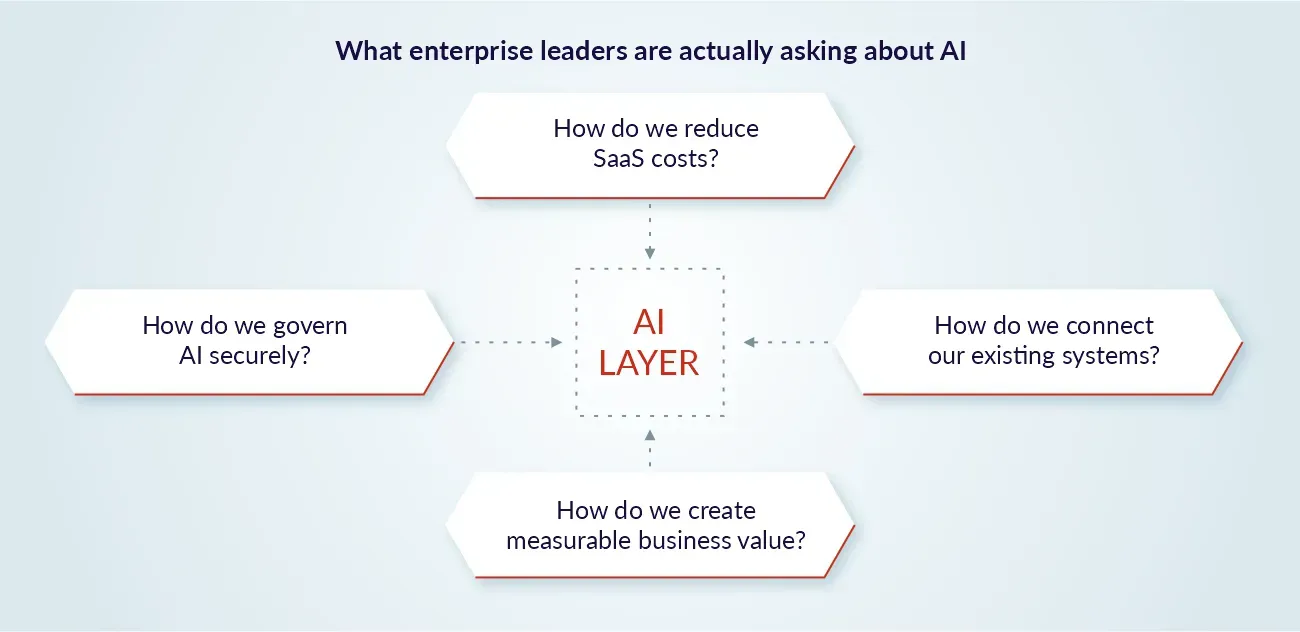
Instead, leaders are asking:
- How do we connect intelligence across existing systems?
- How do we reduce SaaS complexity instead of adding to it?
- How do we govern AI securely across the organization?
- How do we make enterprise data operationally useful in real time?
What stood out most was that the organizations gaining the most traction with AI were not necessarily the ones buying the most AI products.
They were the ones finding ways to make intelligence work across the systems they already had.
The False Premise That Keeps Costing Enterprises Money
Across many of the conversations I had with enterprise leaders, one message surfaced repeatedly:
"We can't rip out our ERP."
"We're not replacing SAP."
"Salesforce is too deeply embedded into the business."
And honestly, most enterprises are right.
Yet much of the AI market continues to promote a different narrative. The assumption is often that existing enterprise systems are outdated, AI-native platforms are the future, and modernization requires replacing legacy infrastructure altogether.
What I heard from enterprise leaders was very different.
Systems such as SAP, Salesforce, NetSuite, and custom-built ERPs already contain years of operational workflows, customer history, reporting logic, and institutional knowledge. Replacing them simply to gain AI capabilities is not always modernization. In many cases, it introduces additional cost, migration risk, and operational disruption.
What enterprises are actually looking for is something much more practical: an intelligence layer that can connect existing systems, synthesize information across them, and make that intelligence actionable without forcing organizations to rebuild their technology stack.
As I mentioned during one strategy discussion:
"Enterprises need an intelligence layer on top of their existing systems — not a replacement for them. The data is already there. The value is in connecting it."
— Jayant Umrani, from a strategic session with enterprise technology leaders, 2026
That shift in thinking is becoming one of the most significant changes in enterprise AI adoption.
The organizations moving fastest with AI are not necessarily replacing their core systems.
They are finding ways to make those systems work together more intelligently.
Why Enterprises Don’t Want to Replace Their Existing Systems
One of the biggest misconceptions in enterprise AI is the assumption that businesses need to replace their core systems to modernize.
In reality, most organizations are not looking to remove systems like SAP, Salesforce, NetSuite, or their existing ERP infrastructure. These platforms already contain years of operational workflows, customer history, reporting structures, and institutional knowledge.
The challenge is not replacing them.
The challenge is connecting them intelligently.
Over the past 18 months, I repeatedly heard enterprise leaders push back against the idea that modernization requires ripping out existing infrastructure. In many cases, that approach creates even more operational risk, cost, and complexity.
The real opportunity is the opposite:
build an intelligence layer that connects existing systems, synthesizes what they already know, and makes that information actionable without forcing expensive migrations.
Several leaders described frustrations with disconnected systems, duplicate workflows, fragmented reporting, and employees constantly switching between platforms just to complete simple operational tasks.
That operational friction is exactly what enterprises are now trying to solve with AI.
What an Enterprise AI Layer Actually Means
An enterprise AI layer is not just middleware or a chatbot sitting on top of enterprise data.
It is an intelligence framework that helps unify information across systems and turn disconnected data into operational insights.
In practical terms, this layer can:
- ingest structured and unstructured data through secure API connections
- surface relevant business context automatically
- automate workflows across systems
- reduce manual handoffs between teams
- and help employees access information conversationally instead of navigating multiple platforms.
The difference becomes significant in day-to-day operations.
For example, a sales rep preparing for a customer conversation should not have to manually cross-reference Salesforce records, support tickets, Slack threads, usage reports, and forecasting spreadsheets separately.
The intelligence layer helps synthesize that context automatically.
Across multiple enterprise conversations, leaders repeatedly emphasized that businesses already have massive amounts of operational data. The problem is that extracting useful intelligence from that data still requires too much manual effort.
Why Private AI Deployments Are Becoming Essential
Another theme that surfaced repeatedly across these discussions was trust.
Enterprise leaders are becoming far more cautious about where their data goes, how AI systems are deployed, and who ultimately controls the environment.
In industries like healthcare, financial services, telecom, and manufacturing, governance and compliance are no longer secondary concerns. They are becoming central buying criteria.
That is why many organizations are prioritizing:
- private cloud deployments
- customer-owned environments
- isolated AI instances
- and governance-first AI architectures
Several enterprise discussions referenced:
- HIPAA compliance
- internal governance frameworks
- CISO approval requirements
- and concerns around external data exposure
What became clear is that enterprise AI adoption depends as much on trust and control as it does on technical capability.
Many of the most forward-looking enterprise buyers are now insisting on architectures that:
- avoid vendor lock-in
- support model flexibility
- maintain data ownership
- and allow AI deployments within their own cloud environments
As several leaders explained, security reviews can no longer happen after deployment decisions are made. Governance now needs to be built into the architecture from the beginning.
How the Enterprise AI Layer Connects Existing Systems
One of the biggest surprises for many enterprise leaders is that the technical architecture behind an intelligence layer is often simpler than expected.
Most enterprise systems already expose APIs.
That means platforms like SAP, Salesforce, NetSuite, SharePoint, Oracle ERP, and custom-built systems can securely connect into a unified intelligence layer without requiring organizations to replace their existing infrastructure.
During one manufacturing-focused discussion, we explored a deployment model where:
- SAP S/4HANA connected through REST APIs for procurement and inventory data
- Salesforce provided customer and pipeline context
- SharePoint supplied access to internal documentation and operational knowledge
- and the intelligence layer synthesized insights across all three systems
The data itself did not need to move.
The intelligence did.
That distinction became important in several enterprise security discussions because it helped address governance and compliance concerns early in the process.
As I shared during a technical briefing earlier this year:
“We connected Atlas to SAP, Salesforce, and SharePoint for a manufacturing client. From integration to first production query was 16 hours. The same outcome with traditional middleware would have taken months.”
— Jayant Umrani, from a technical briefing on deployment architecture, 2026
The Enterprise AI Gap Many Organizations Are Trying to Solve
Across these conversations, another pattern became clear.
Enterprise buyers often feel stuck between two extremes:
- lightweight AI tools that are easy to deploy but limited in scalability and governance
- or large enterprise AI initiatives that require massive budgets, long timelines, and specialized engineering teams
Several leaders described a growing demand for something in the middle:
enterprise-grade AI that can deploy quickly, connect securely to existing systems, and operate without creating additional operational complexity.
This gap surfaced repeatedly in discussions around:
- rising SaaS costs
- fragmented AI tooling
- governance concerns
- and the need for faster operational results
What many enterprises are ultimately looking for is not another isolated AI product.
They are looking for connected enterprise intelligence.
What This Looks Like in Practice
The starting point for an enterprise AI layer varies by organization.
For some mid-market businesses, it may begin with unifying sales and finance visibility so forecasting conversations happen in real time instead of through spreadsheets.
For larger enterprises, it may start with operational bottlenecks where information gets lost between departments, such as sales-to-customer-success transitions, reporting workflows, or approval processes.
Across the discussions I participated in, the most successful AI initiatives typically started:
- where operational friction was highest
- where data already existed
- and where measurable business value could be demonstrated quickly
The intelligence layer then expanded from there.
Conclusion
Over the last year, enterprise AI conversations have shifted significantly.
Leaders are no longer asking whether AI matters. Most organizations have already moved beyond that stage.
The real discussion now is about:
- integration
- governance
- operational scalability
- data accessibility
- and measurable business outcomes
What stood out across conversations with enterprise leaders was that businesses do not want more disconnected AI products.
They want connected intelligence across the systems they already use.
That is why the concept of the enterprise AI layer is gaining so much attention. It addresses one of the biggest operational challenges enterprises face today: how to unify fragmented systems without adding even more complexity.
Ultimately, the organizations that gain the most value from AI over the next few years may not be the ones buying the most tools.
They may be the ones building the most connected intelligence layer across the business.
FAQs
An enterprise AI layer is a technology layer that connects data and workflows across existing business systems such as Salesforce, SAP, NetSuite, ERPs, and internal knowledge repositories. It helps organizations generate insights, automate workflows, and access information without replacing their core systems.
Many organizations are struggling with fragmented AI environments, rising licensing costs, and disconnected data. Enterprise leaders increasingly prefer solutions that unify intelligence across existing systems rather than introducing additional standalone tools.
No. One of the biggest trends discussed by enterprise leaders is the desire to build AI capabilities on top of existing systems. The goal is to enhance current investments rather than replace them.
Private AI deployments help organizations maintain control over their data, meet compliance requirements, strengthen governance, and reduce dependency on external AI providers.
Common challenges include disconnected systems, data silos, governance requirements, security concerns, rising AI costs, and proving measurable business value.
Organizations are increasingly evaluating AI based on operational efficiency, workflow automation, faster decision-making, improved visibility, cost control, and measurable business outcomes rather than experimentation alone.
Enterprise AI is moving toward connected intelligence layers that unify systems, automate workflows, and make business data more accessible and actionable across the organization.
Yes. Many organizations are using AI to connect and enhance existing platforms through integrations, APIs, and intelligent automation rather than undertaking costly system replacement initiatives.