Executives Want Reliability. Customers Want Consistency. Salesforce Field Service Delivers Both.

For CXOs and industry leaders responsible for service performance, field service has become one of the hardest areas to keep under control.
On paper, service operations may look reliable. Forecasts are approved. SLAs are defined. Reports show acceptable performance. But on the ground, customers experience something very different — missed arrival windows, inconsistent resolution quality, and repeated follow-ups for the same issue. What leadership expects to be predictable often feels fragmented once it reaches the field.
Executives prioritize reliability for good reasons. Unplanned costs, last-minute escalations, and limited visibility create risk, but reputationally. Customers, meanwhile, measure service in far simpler terms. They expect the same experience every time they interact with your brand, regardless of location, technician, or channel. In fact, 76% of customers expect companies to understand their needs and expectations. When that consistency breaks, trust erodes quickly.
Without a modern field service platform, organizations are forced to manage this gap manually. Leaders lack real-time insight into what’s actually happening, while frontline teams are left to rely on workarounds and personal judgment. The result is a service model that looks stable from the top but feels unreliable to the customer.
Salesforce Field Service closes this gap by connecting strategy with execution. It brings service data, workflows, and field teams onto a single platform designed for real-time coordination. Schedules adapt as conditions change. Technicians work from standardized, guided processes. Leadership gains clear visibility into performance as it happens — not after the damage is done. Salesforce Field Service clients have reported reduced service response times and improved SLA adherence after implementation.
For executives, this means reliable operations that can scale without introducing chaos. For customers, it means consistent, dependable service every time they engage. Salesforce Field Service turns field service from a constant source of friction into a measurable advantage — delivering the reliability of leadership demands and the consistency customers expect.
Reliability for Executives, Consistency for Customers — Why Both Depend on the Same Foundation
For executives, reliability comes down to a few simple things: knowing what service will cost, how it will perform, and when something is going wrong. Fewer surprises. Fewer escalations. Clear visibility into what’s actually happening beyond reports and spreadsheets.
Customers look at service very differently. They care about whether the experience feels the same every time. The right technician shows up. The problem gets fixed. Communication is clear. When service feels unpredictable, trust drops fast — even if the issue itself is small.
The problem is that these two expectations are tightly connected. When service delivery varies from one visit to the next, leaders feel it as missed SLAs, rising costs, and late-stage escalations. What customers experience as inconsistency, executives experience as risk.
Reliability for leadership and consistency for customers come from the same place: repeatable processes, shared information, and real-time visibility across the field. When those basics aren’t in place, both sides feel the impact at the same time.
Salesforce Field Service: The Bridge Between Strategy and Execution
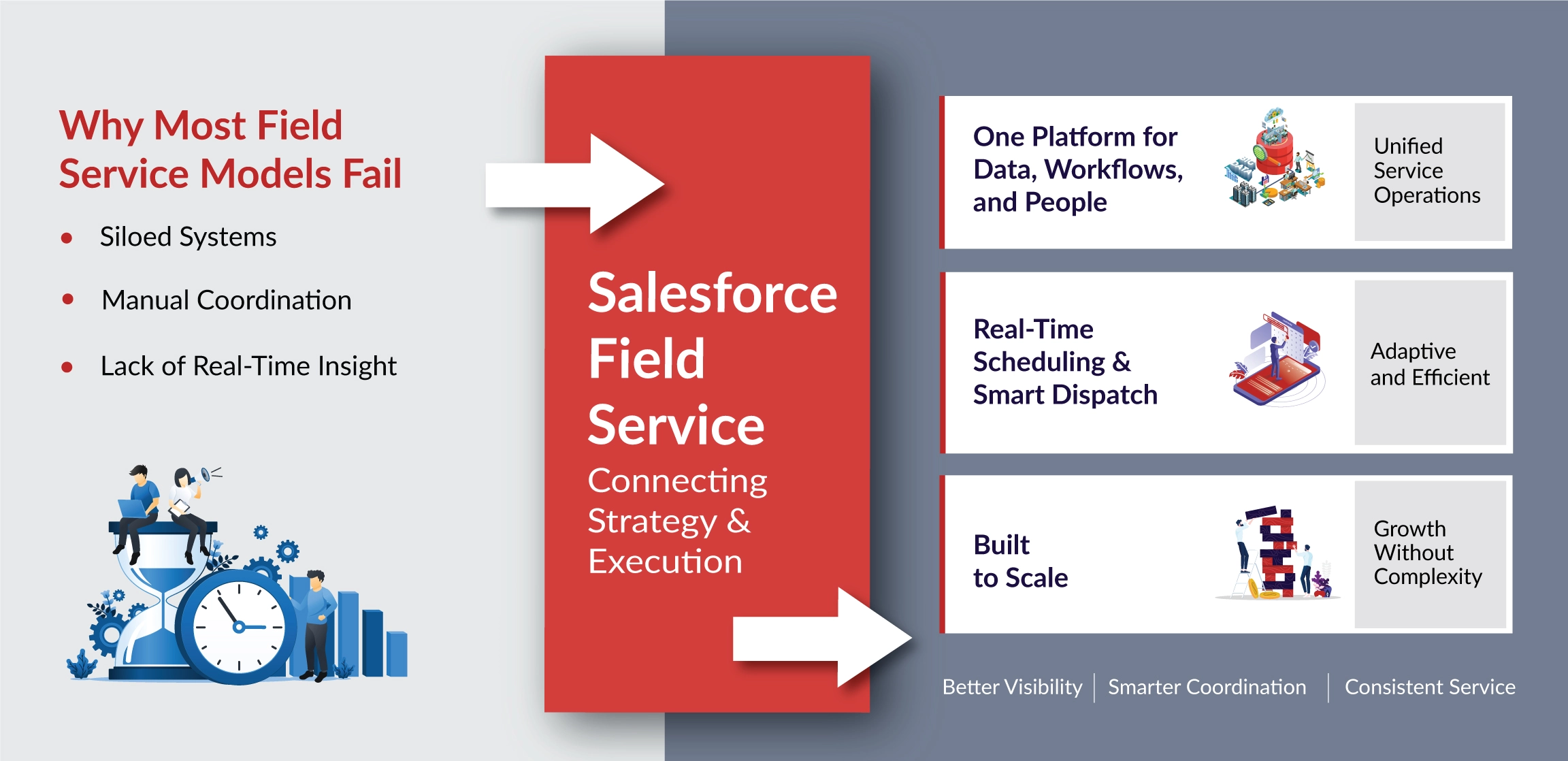
Most field service models fail because they were never designed to connect strategy with day-to-day execution. Data lives in different systems, schedules are managed in isolation, and frontline teams operate without full context. What leadership plans and what happens in the field rarely move in sync.
Salesforce Field Service closes this gap by bringing data, workflows, and people onto one connected platform. Instead of relying on disconnected tools and manual coordination, service teams work from a shared source of truth that reflects what’s happening in real time.
Scheduling and dispatch adapt as conditions change — whether that’s a delayed job, a last-minute emergency, or shifting technician availability. This allows organizations to respond quickly without throwing the entire service operation off balance.
Because Salesforce Field Service is built to scale, standard processes can be applied across regions and teams without adding layers of complexity. Leaders gain visibility and control, technicians get the clarity they need to execute confidently, and service delivery stays aligned with business priorities as the organization grows.
How Salesforce Field Service Delivers Reliability and Consistency
Salesforce Field Service works because it focuses on what actually breaks service operations — unpredictability, uneven execution, and poor communication. Instead of fixing these issues in isolation, it brings them together under one connected service model.
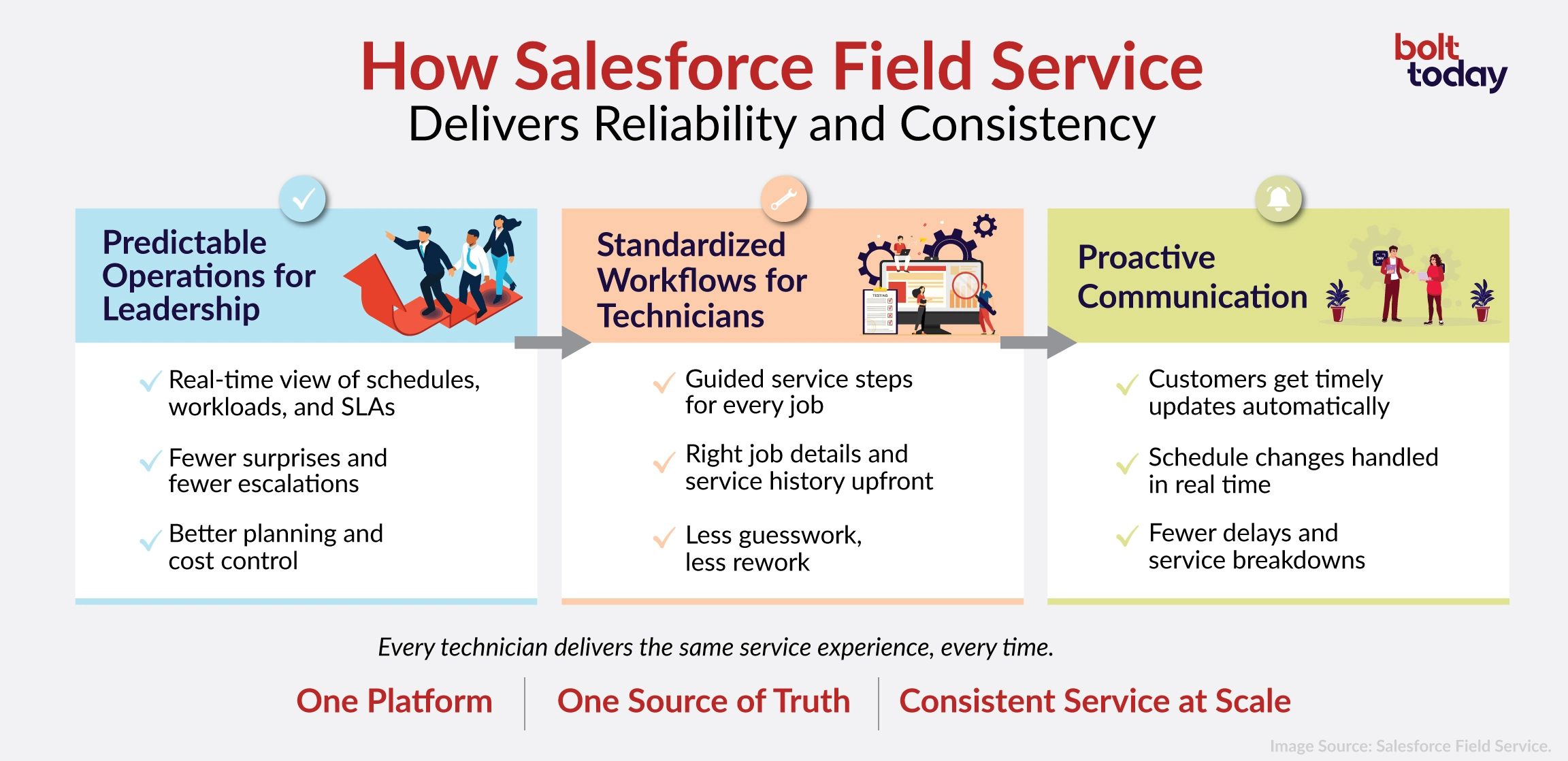
Image source: Salesforce Field Service
Final Thoughts
Reliability and consistency are no longer optional in field service. They shape how leaders plan, how teams operate, and how customers decide to stay. Predictable operations build leadership confidence. Consistent experiences build customer trust. One cannot exist without the other.
Salesforce Field Service provides the foundation to deliver both — connecting data, workflows, and field teams in real time, so service moves from reactive to repeatable, and from fragile to scalable.
As the leading Salesforce AI consultancy, we help businesses design, implement, and optimize Salesforce Field Service in a way that fits how their service operations actually work. At Bolt Today, we focus on clarity first — aligning data, workflows, and decision-making before automation and scale. This ensures Salesforce Field Service delivers real operational impact, not just system change.
Whether you’re modernizing an existing service model or preparing for growth, Bolt Today helps turn Salesforce Field Service into a dependable engine for reliability, consistency, and long-term service excellence.