Quick Links
- Why Does Enterprise AI Cost More Than the Software?
- Hidden Cost #1: Disconnected Enterprise Data
- Hidden Cost #2: AI Governance and Compliance
- Hidden Cost #3: Integration Complexity
- Hidden Cost #4: Human Adoption
- Hidden Cost #5: Measuring Business Value
- What Enterprise Leaders Are Doing Differently
- What Enterprise AI Leaders Should Take Away
- FAQs
The Hidden Costs of Enterprise AI That Don't Appear on Your Invoice

Key Takeaways
- The true cost of enterprise AI extends far beyond software licenses and implementation.
- Disconnected data, governance, integration, and employee adoption are often the biggest hidden costs.
- AI initiatives deliver greater value when success is measured through clear business outcomes, not technical capabilities.
- Enterprise leaders are prioritizing connected, governed, and outcome-driven AI strategies over adding more standalone tools.
- Identifying hidden operational costs early helps organizations scale AI more efficiently and with greater confidence.
One thing I've noticed in conversations with enterprise leaders is that most discussions around AI costs begin with the software.
Questions about licensing, model pricing, API consumption, and implementation budgets often dominate the conversation. While those costs are important, they are rarely the ones that determine whether an AI initiative succeeds or becomes far more expensive than expected.
The costs that catch many organizations by surprise tend to appear after implementation.
As AI becomes part of day-to-day operations, enterprises begin dealing with challenges that never appeared on the original invoice: fragmented data spread across multiple systems, governance and compliance requirements, complex integrations, manual oversight, and the organizational change needed to help teams adopt AI effectively.
These aren't hidden because they're insignificant. They're hidden because they rarely receive the same attention during planning as software licensing or implementation costs.
One observation from a discussion with enterprise technology leaders captured this shift well:
"Companies don't want another tool. They want intelligence across existing systems."
That statement reflects a broader reality. The real cost of enterprise AI is often not the AI itself. It's everything required to make that AI useful, secure, and scalable within the business.
In this blog, I'll explore the operational costs that enterprise leaders are increasingly discussing—and why understanding them early can make the difference between successful AI adoption and an initiative that struggles to deliver long-term value.
Why Does Enterprise AI Cost More Than the Software?
One pattern surfaced repeatedly in conversations with enterprise leaders: budgeting for AI is relatively straightforward. Operating AI across the business is where the real complexity begins.
Most organizations account for the visible costs upfront—AI platforms, software licenses, implementation services, and infrastructure. Those expenses are expected and can usually be planned for.
The challenge comes after deployment.
As AI moves into day-to-day operations, organizations need to connect multiple enterprise systems, prepare and govern data, maintain integrations, monitor AI outputs, and establish the policies required to use AI securely at scale. These activities require ongoing investment in time, people, and processes, yet they rarely appear in the initial business case.
That shift is important. Connecting AI to existing systems is often far more complex than deploying the AI itself. Across many of the discussions, enterprise leaders emphasized that creating connected intelligence across existing systems is becoming a higher priority than investing in additional standalone AI tools.
It became clear that AI isn't always the most expensive part of an enterprise AI initiative.
Operating AI at enterprise scale is.
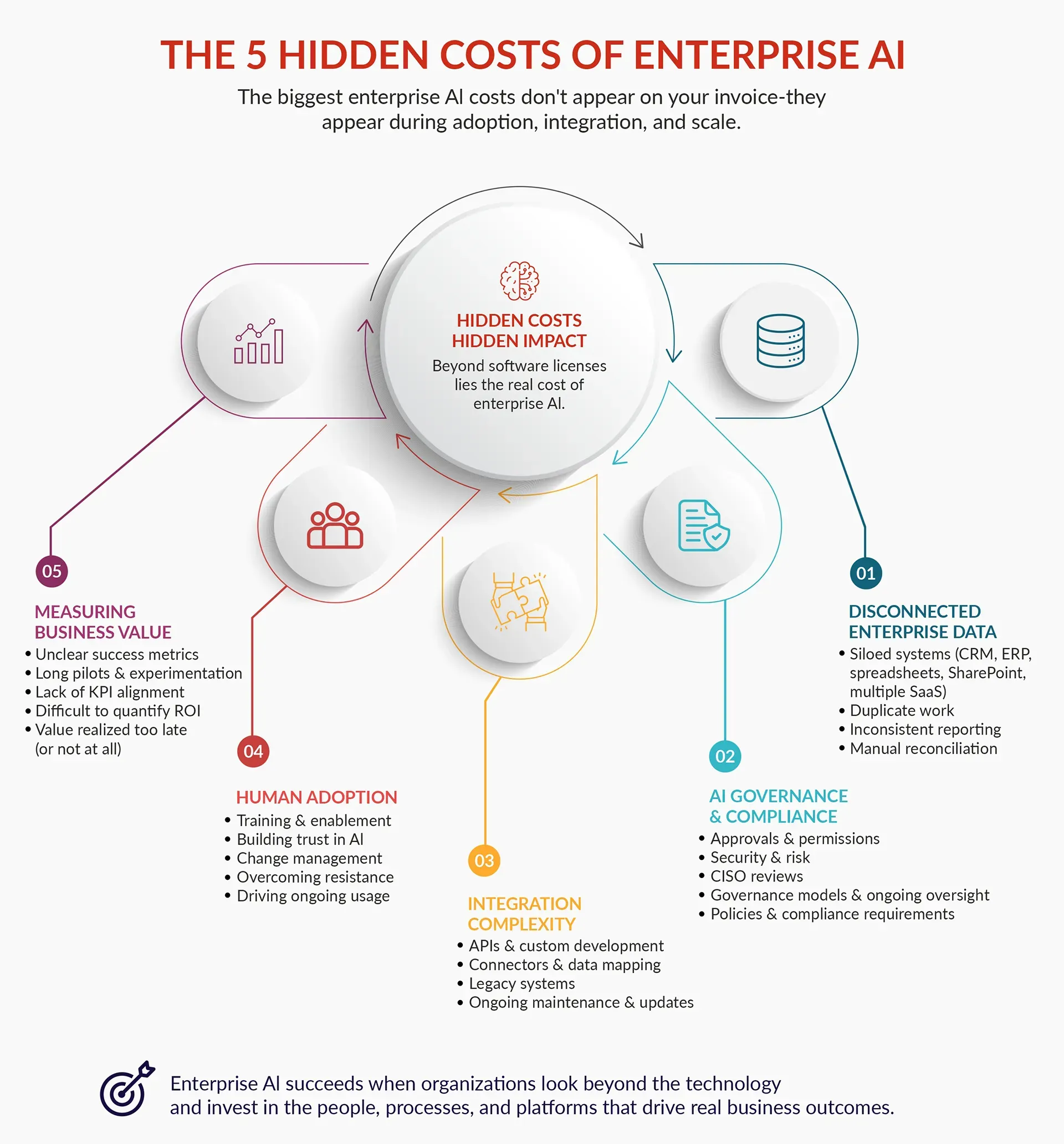
Hidden Cost #1: Disconnected Enterprise Data
One of the most common themes across conversations with enterprise leaders was that AI is only as effective as the data it can access.
In many organizations, business information is spread across CRMs, ERP platforms, SharePoint, spreadsheets, reporting tools, and multiple SaaS applications. While each system serves a purpose, they often operate in isolation, making it difficult for AI to deliver complete and reliable insights.
The cost isn't the software itself. It's the operational effort required to bridge the gaps between these systems.
Teams spend valuable time switching between applications, reconciling conflicting data, and manually piecing together information before they can make decisions. The result is duplicate work, inconsistent reporting, and delayed insights—all of which reduce the value AI is expected to deliver.
Rather than adding another AI application to an already fragmented technology stack, enterprise leaders are increasingly focused on connecting the systems they already have so information can move more seamlessly across the business.
The real hidden cost isn't having multiple business systems. It's the time and effort required to make disconnected data work together.
Hidden Cost #2: AI Governance and Compliance
Another theme that surfaced consistently in conversations with enterprise leaders was the growing importance of AI governance.
As organizations move beyond experimentation, deploying AI is no longer just a technology decision. It also requires approval from security, compliance, and risk teams to ensure AI is used responsibly across the business.
Leaders repeatedly discussed the need for governance models, CISO reviews, risk assessments, role-based access controls, and approval frameworks before AI solutions could be deployed at scale. These aren't one-time tasks—they become an ongoing part of operating enterprise AI.
One discussion highlighted the importance of implementing formal AI governance models for risk evaluation and proposal approvals, while another emphasized that security should be treated as a design criterion rather than an afterthought.
These activities rarely appear on an implementation invoice, yet they require significant time, coordination, and internal resources.
The hidden cost isn't simply deploying AI. It's building the policies, oversight, and governance frameworks that allow organizations to use AI securely and confidently at enterprise scale.
Hidden Cost #3: Integration Complexity
One of the biggest misconceptions in enterprise AI is that when results fall short, the AI is to blame.
Across many conversations with enterprise leaders, a different reality emerged. More often than not, the challenge wasn't the AI itself—it was that the AI wasn't connected to the systems where the business data lived.
Enterprise information is spread across CRMs, ERP platforms, SharePoint, legacy applications, and other business systems. For AI to deliver meaningful insights or automate workflows, it needs secure access to that data. That means building and maintaining APIs, connectors, and integrations across the existing technology landscape.
Without those connections, even the most capable AI models have limited business context.
As I shared during one discussion with enterprise technology leaders:
"Enterprises need an intelligence layer on top of their existing systems—not a replacement for them. The data is already there. The value is in connecting it."
That perspective reflects an important shift. The challenge is no longer whether AI can generate answers. It's whether AI can access the right information at the right time.
This is also why pre-built connectors are becoming increasingly valuable. When integrations with platforms such as Salesforce, SAP, NetSuite, or SharePoint already exist, organizations can spend less time building infrastructure and more time validating business outcomes.
The hidden cost isn't the AI platform. It's the effort required to connect AI to the systems that power the business.
Hidden Cost #4: Human Adoption
Another insight that surfaced repeatedly in conversations with enterprise leaders was that technology is only one part of successful AI adoption.
Deploying an AI platform may take weeks, but helping people use it effectively is an ongoing investment. Employees need to understand when to use AI, how to use it responsibly, and where human oversight remains essential.
Leaders frequently discussed the importance of training, governance, phased rollouts, and change management to build trust across the organization. Rather than introducing AI everywhere at once, many organizations are starting with focused use cases, establishing clear policies, and helping teams gain confidence before expanding adoption.
One discussion highlighted the importance of fostering a culture of curiosity and ownership so employees become active participants in AI transformation rather than passive users.
That reflects an important reality: enterprise AI delivers value only when employees trust it enough to make it part of their daily workflows.
The hidden cost isn't simply deploying AI. It's investing the time and effort needed to help people adopt it successfully.
Hidden Cost #5: Measuring Business Value
One of the strongest themes across conversations with enterprise leaders was the shift from AI experimentation to measurable business outcomes.
Many organizations have spent months running pilots, testing use cases, and exploring AI capabilities. But one question often determines whether those initiatives move forward:
What does success actually look like?
Without clearly defined business outcomes, it's difficult to evaluate whether an AI initiative is delivering value. Leaders repeatedly emphasized that success should be measured through operational improvements—such as faster workflows, improved productivity, reduced manual effort, or better decision-making—rather than simply proving that the AI works.
As one discussion highlighted, the industry is moving away from labor-intensive AI projects and toward intelligent services that deliver faster, measurable business results.
That shift is changing how enterprises evaluate AI investments. Instead of asking, "Can this AI solution work?" they're asking, "Can it create meaningful business value?"
The hidden cost isn't experimenting with AI. It's spending time, budget, and resources on initiatives without defining the outcomes that matter most.
What Enterprise Leaders Are Doing Differently
Across these conversations, one thing became increasingly clear: enterprise leaders are becoming more deliberate in how they approach AI adoption.
Instead of adding more standalone AI tools, they're looking for ways to build connected intelligence across the systems they already use. The focus is shifting toward unified AI strategies that improve operational efficiency rather than adding another layer of complexity.
Governance is also being treated as a foundational requirement rather than something to address after deployment. Security, compliance, and risk management are now influencing AI decisions from the outset, helping organizations scale AI with greater confidence.
Another noticeable shift is how success is being measured. Rather than investing in lengthy pilots with uncertain outcomes, leaders are prioritizing faster validation through focused use cases tied to clear business objectives. The emphasis is no longer on demonstrating AI capabilities—it's on proving measurable business value.
Together, these priorities reflect a broader shift in enterprise AI strategy. Organizations are moving away from fragmented AI initiatives and toward connected, governed, and outcome-driven approaches that create lasting operational value.
What Enterprise AI Leaders Should Take Away
Across these conversations with enterprise leaders, one thing became increasingly clear: the cost of enterprise AI extends well beyond software licenses and implementation budgets.
While organizations often plan for platform costs, the factors that have the greatest impact on long-term success are rarely found on an invoice. Connecting enterprise systems, governing AI responsibly, building trust among employees, maintaining integrations, and measuring business outcomes all require ongoing investment.
What stood out most was that the organizations making the greatest progress with AI were not necessarily the ones investing in the most tools. They were the ones taking a more disciplined approach—prioritizing connected data, governance, rapid validation, and measurable business value from the start.
The hidden cost of enterprise AI isn't the AI itself.
It's everything organizations underestimate around it.
At Bolt Today, we've seen that enterprises achieve better results when they identify these operational challenges early and validate value before scaling AI across the business. Whether you're looking to modernize workflows, connect existing systems, or build a secure and scalable AI strategy, our team can help you identify where hidden costs may exist and how to address them before they slow your transformation.
FAQs
Beyond software licensing, enterprise AI often involves hidden costs such as disconnected data, governance and compliance, system integration, employee adoption, and measuring business outcomes.
When business data is spread across multiple systems, organizations spend more time reconciling information, maintaining integrations, and manually connecting workflows before AI can deliver meaningful insights.
Governance helps organizations deploy AI securely by establishing policies, approvals, access controls, and compliance processes that reduce operational and regulatory risk.
Organizations can reduce hidden costs by connecting existing systems, establishing governance early, validating business value quickly, and focusing on measurable outcomes rather than deploying more standalone AI tools.