How to Modernize Financial Services Without Replacing Legacy Systems

Key Takeaways
- AI adoption doesn't require replacing legacy systems. Financial institutions can modernize by integrating AI with their existing technology.
- Focus on business impact first. Identify high-value processes where AI can improve efficiency, customer experience, and decision-making.
- Start small and scale strategically. Launch measurable AI initiatives, prove ROI, and expand successful use cases over time.
- Data and governance are the foundation of successful AI. Connected data, security, compliance, and responsible AI practices are essential for long-term success.
- Technology should support your strategy—not define it. The most successful organizations focus on solving business challenges before choosing AI tools or platforms.
Do you really need to replace your legacy systems to take advantage of AI?
It's a question many financial institutions are asking as AI continues to reshape customer expectations, operational efficiency, and decision-making. The assumption is often the same: before adopting AI, existing banking, lending, or insurance systems need to be replaced with modern platforms.
In reality, that's rarely the case.
For many organizations, the idea of a complete technology overhaul creates more hesitation than momentum. Replacing core systems can involve significant costs, lengthy implementation timelines, regulatory complexities, operational disruption, and the challenge of managing change across the business. As a result, AI initiatives are often delayed, not because the technology isn't valuable, but because the path to adoption seems too risky.
The good news is that modernizing financial services doesn't have to start with replacing everything. In many cases, AI can be introduced alongside existing systems, helping automate processes, improve customer experiences, and support employees while preserving the technology investments already in place.
The key is to take a practical, phased approach, one that focuses on solving high-impact business challenges first and gradually builds a stronger foundation for long-term AI adoption. This roadmap allows financial institutions to modernize with confidence, delivering measurable value without the disruption of a complete system replacement.
Why "Replace Everything" Isn't a Realistic Strategy
If replacing legacy systems were easy, every financial institution would have done it by now.
The reality is very different.
Banks, lenders, insurance providers, and other financial organizations have invested years, often decades, into building the systems that run their business. These platforms process transactions, manage customer data, support compliance, and keep critical operations running every day.
Replacing them isn't just a technology decision. It's a business decision with far-reaching implications.
What's standing in the way?
Instead of one big challenge, organizations are often dealing with several at once:
- Significant existing investments in systems that still perform their core functions.
- Mission-critical operations that can't be paused while new technology is implemented.
- Strict regulatory and compliance requirements that make large-scale changes more complex.
- High implementation costs with no guarantee of immediate returns.
- Employee adoption challenges, as teams need time and training to embrace new tools.
- Long project timelines, during which business priorities and customer expectations may continue to evolve.
When all of these factors come together, it's easy to see why many modernization projects slow down, or never move beyond the planning stage.
"Modernization doesn't have to mean starting over. Sometimes, it means making what you already have work smarter."
That's why many financial institutions are shifting their mindset. Instead of planning a complete replacement, they're identifying areas where AI can improve existing processes, automate repetitive work, and deliver measurable results without disrupting the systems they already rely on.
The better question to ask is "What should we improve first?" instead of "What should we replace?"
Where Can AI Deliver Value Without Replacing Existing Systems?
Once organizations move past the idea of replacing everything, the next question is usually:
"Where should we start?"
The answer is simpler than many expect. Instead of targeting your core systems, start with the processes around them, the repetitive, time-consuming tasks that slow employees down and impact customer experience.
Here are a few areas where AI can make an immediate difference.
1. Customer Service: Faster Support, Better Experiences
Customers expect quick, accurate responses. AI-powered assistants can help customer service teams answer common questions, route requests to the right department, and provide agents with relevant information during conversations.
The result? Faster case resolution, shorter wait times, and more time for employees to focus on complex customer needs.
2. Operations: Reduce Manual Work
Many financial processes still rely on manual effort, from reviewing documents to processing applications.
AI can help automate tasks such as:
- Extracting information from documents
- Processing loan applications
- Supporting insurance claims reviews
- Speeding up account onboarding
These improvements don't replace existing workflows, they simply make them faster and more efficient.
3. Risk & Compliance: Stay Ahead of Potential Issues
Managing risk is a constant priority in financial services, and AI can strengthen existing compliance processes.
For example, organizations can use AI to:
- Detect unusual transaction patterns
- Support fraud detection
- Assist with compliance reviews
- Flag exceptions that need human attention
Rather than replacing compliance teams, AI helps them focus on the areas that require the most attention.
4. Employee Productivity: Help Teams Work Smarter
Not every AI use case needs to face the customer.
Internal AI assistants can help employees quickly find policies, summarize customer interactions, draft reports, and access information without searching through multiple systems.
Small improvements like these can save valuable time every day, allowing teams to focus on higher-value work instead of repetitive administrative tasks.
The biggest AI wins often come from improving everyday work—not replacing the systems that support it.
The common thread across all of these use cases is that they work alongside your existing technology. Instead of replacing core banking, lending, or insurance platforms, AI enhances the processes around them, helping organizations deliver value faster while reducing the cost and risk of modernization.
A Practical AI Modernization Roadmap
Successful AI adoption isn't about making one big leap, it's about taking a series of smart, manageable steps.
Instead of asking, "How do we modernize everything?", ask, "What's the next improvement that will create real business value?"
Here's a roadmap that many financial institutions can follow.
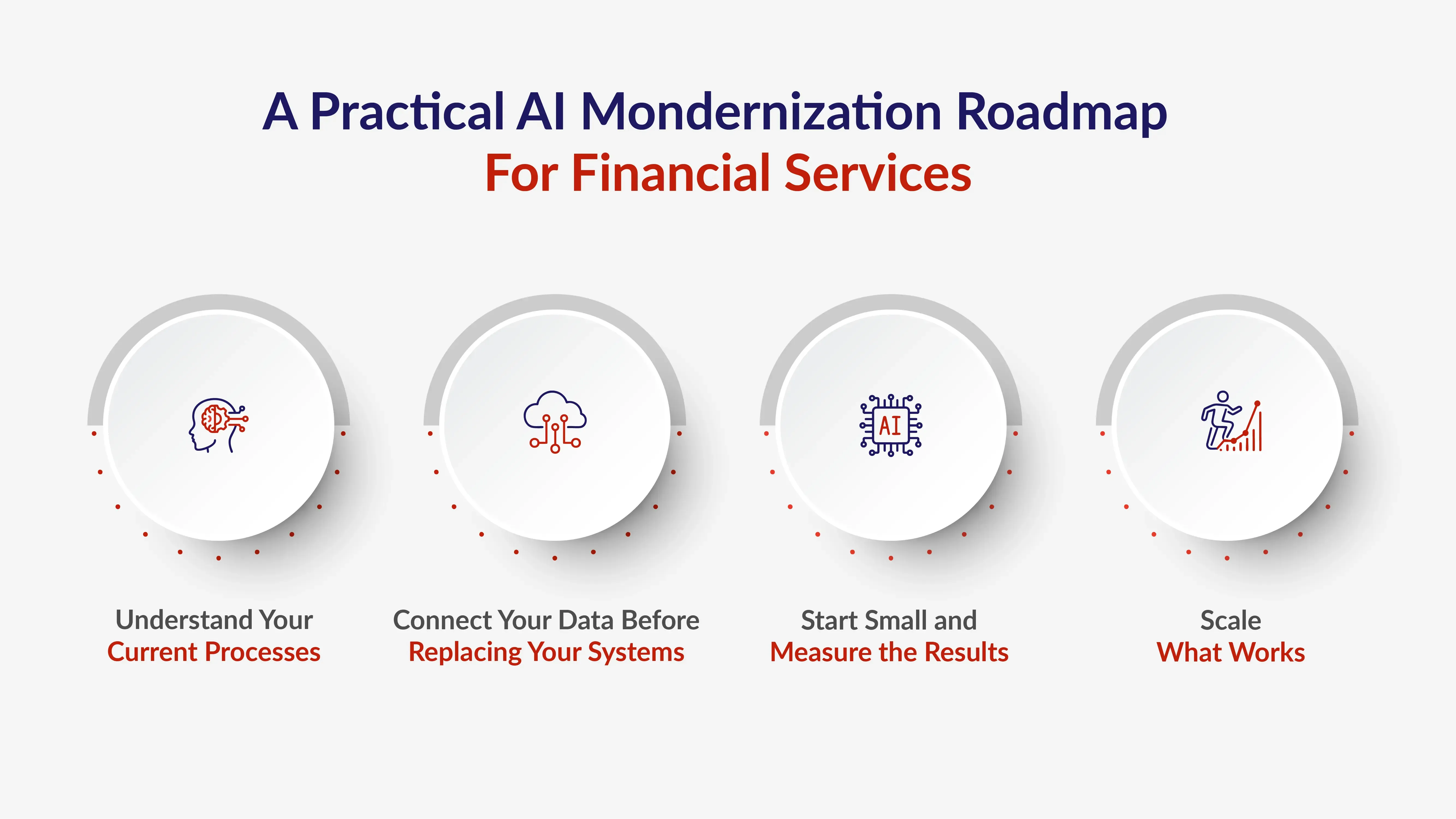
Step 1: Understand Your Current Processes
Before introducing AI, take a closer look at how work gets done today.
Which tasks consume the most time? Where do employees switch between multiple systems? Which processes rely heavily on manual work?
These are often the best places to begin because even small improvements can have a noticeable business impact.
Look for opportunities such as:
- Repetitive manual tasks
- Process bottlenecks
- Delays caused by approvals or document reviews
- High-volume workflows that affect customers every day
The goal isn't to automate everything. It's to identify the work that creates the biggest opportunity for improvement.
Step 2: Connect Your Data Before Replacing Your Systems
One of the biggest misconceptions about AI is that it needs brand-new technology.
In reality, AI is only as effective as the data it can access.
Instead of replacing existing platforms, many organizations start by connecting them through APIs and integrations. This allows AI to access information from multiple systems, creating a more complete view of customers, operations, and business processes.
At the same time, improving data quality and consistency helps ensure AI produces reliable, trustworthy results.
Remember: Better data often delivers more value than newer software.
Step 3: Start Small and Measure the Results
You don't need dozens of AI projects running at once.
Choose one or two use cases that solve a clear business problem and can deliver measurable results within a reasonable timeframe.
Some common starting points include:
- An AI assistant for customer support
- Automated document processing
- Internal knowledge search for employees
- AI-powered fraud alerts
Once these projects are live, track outcomes that matter to the business, such as:
- Time saved
- Processing accuracy
- Customer satisfaction
- Operational costs
Small wins build confidence, generate stakeholder support, and provide valuable lessons before expanding AI across the organization.
Step 4: Scale What Works
Once you've proven value, don't stop there.
Use the insights from your initial projects to expand AI into other departments and workflows. What started in customer service might support operations, compliance, or finance next.
As AI adoption grows, it's equally important to strengthen governance, establish clear policies, and ensure every new initiative aligns with business goals and regulatory requirements.
The organizations seeing the greatest success aren't necessarily the ones investing the most in AI, they're the ones scaling thoughtfully, learning from each implementation, and continuously improving along the way.
Modernization isn't a one-time project. It's a journey of continuous improvement, with AI helping organizations get more value from the systems they already have.
Build the Right Foundation Before Choosing the Right Technology
It's easy to get caught up comparing AI platforms, evaluating new tools, and searching for the "best" solution.
But successful AI modernization isn't determined by the technology you choose, it's determined by the foundation you build before implementing it.
Before investing in any AI solution, ask yourself:
- Do we have a clear business problem we're trying to solve?
- Can AI access accurate, reliable data across our existing systems?
- Are our processes designed to support both employees and customers?
- Do we have the right governance to use AI securely and responsibly?
These questions matter because AI in financial services isn't just about improving efficiency. It's also about building trust.
Whether AI is helping detect fraud, support customer interactions, or assist with compliance reviews, organizations need to ensure that customer data is protected, AI-generated insights can be explained, and employees remain involved in high-impact decisions. Strong governance also helps businesses meet regulatory requirements while scaling AI with confidence.
The most successful AI initiatives aren't built on the newest technology. They're built on trusted data, clear objectives, and responsible governance.
When these foundations are in place, choosing the right AI platform becomes much simpler. Technology should enable your business strategy, not define it.
By focusing on business outcomes first and technology second, financial institutions can build AI solutions that are secure, scalable, and capable of delivering long-term value.
The Next Step in Your AI Journey
Modernizing financial services isn't about replacing every legacy system, it's about improving the areas that create the greatest business impact. By starting with practical, measurable AI initiatives, financial institutions can reduce risk, demonstrate ROI, and scale AI with confidence, all while making the most of their existing technology investments.
The future of financial services won't belong only to institutions with the newest technology. It will belong to those that make the smartest use of the technology they already have.
As a leading AI-powered Salesforce consulting company, Bolt Today helps financial services organizations identify the right AI opportunities, integrate them with existing systems, and modernize with a practical, business-first approach.
Ready to unlock more value from your existing technology? Connect with our experts to build an AI roadmap tailored to your business goals.
FAQs
Yes. Financial institutions can adopt AI without replacing their existing legacy systems. By using APIs, integrations, and intelligent automation, AI can work alongside core banking, lending, or insurance platforms to improve processes, enhance customer experiences, and increase operational efficiency.
The best place to start is by identifying repetitive, high-impact business processes. From there, organizations should connect existing data sources, launch small AI initiatives with measurable outcomes, and gradually scale successful use cases across the business.
AI can help financial institutions:
- Improve customer service
- Automate manual processes
- Strengthen fraud detection and compliance
- Increase employee productivity
- Reduce operational costs
- Make faster, data-driven decisions
AI governance helps ensure that AI systems are secure, transparent, and compliant with industry regulations. It includes protecting customer data, maintaining human oversight, ensuring explainability, and promoting the responsible use of AI across the organization.
Some of the most common AI use cases include AI-powered customer support, document processing, loan and account onboarding, fraud detection, compliance monitoring, internal knowledge assistants, and intelligent workflow automation.
As a leading AI-powered Salesforce consulting company, Bolt Today helps financial services organizations identify high-impact AI opportunities, integrate AI with existing Salesforce and enterprise systems, and implement secure, scalable solutions that deliver measurable business value without unnecessary disruption.