Quick Links
- What Is AI Expected to Solve in Forecasting?
- Why Does Forecasting Still Go Wrong Even with AI?
- What Are the Limitations of AI in Forecasting?
- Why Do You Need Both AI and Human Judgment in Forecasting?
- What Improves Forecast Accuracy in RevOps?
- What Role Does RevOps Play in Forecast Accuracy?
- What Are Common Forecasting Mistakes in RevOps?
- What This Means for Forecasting Accuracy
- FAQs
Why AI Isn’t Enough to Improve Forecasting Accuracy in RevOps

Because forecasting depends on clean data, consistent processes, and team alignment. AI can analyze and predict, but it can’t fix poor inputs or inconsistent ways of working.
Now, if you’re in RevOps, this might sound familiar.
Are your forecasts still slipping, even after bringing AI into the picture?
You’ve probably added tools that promise better visibility into your pipeline. On paper, it feels like forecasting should be getting easier.
The numbers don’t fully add up. Some deals look solid in the system but don’t feel that way in reality. Reps share updates that were never logged. And in the end, you’re still relying on instinct to make the final call.
That’s the gap.
AI in forecasting isn’t the problem, but it isn’t the fix either. Forecasting doesn’t improve just because you add smarter tools. It improves when your data is accurate, your process is consistent, and your system reflects how your team actually works.
Without that, AI just ends up showing you the same issues—just in a more polished way.
What Is AI Expected to Solve in Forecasting?
It’s not hard to see why AI has become such a big part of forecasting.
At its best, it promises to take something that’s usually messy and turn it into something more clear and reliable.
Instead of relying only on what reps think or manual updates, AI can look at past data and suggest how deals might move. It can scan your pipeline in real time and point out risks early. It can even pick up patterns across deals that are easy to miss.
That’s a meaningful shift.
For RevOps teams, it changes forecasting from looking back at what already happened to getting a sense of what’s likely to happen next.
And that’s why so many teams are investing in it.
On the surface, it feels like the missing piece—something that can bring more consistency and remove guesswork from forecasting. If AI can handle more data and spot trends better than humans, then better forecasts should follow.
At least, that’s the expectation.
Why Does Forecasting Still Go Wrong Even with AI?
If AI in forecasting is so powerful, why do forecasts still go wrong?
Because most forecasting issues don’t start with a lack of intelligence. They start much earlier—at the foundation.
1. Data quality is the first crack
If your CRM data is incomplete, outdated, or inconsistently filled in, AI doesn’t correct it—it relies on it. Missing close dates, inflated deal values, or inactive opportunities sitting in the pipeline all feed directly into the forecast. The output might look sophisticated, but it’s still based on unreliable inputs.
2. Then comes process inconsistency
When deal stages aren’t clearly defined—or worse, interpreted differently by each rep—your pipeline stops being a system and becomes a collection of opinions. One rep’s “Commit” is another rep’s “Best Case.” Without consistent rules, forecasting becomes subjective, no matter how advanced the tooling is.
3. And finally, team misalignment.
Sales, marketing, and customer success often operate with different definitions of pipeline, conversion, and revenue stages. So while AI is trying to analyze the full picture, the inputs themselves don’t align. Instead of creating clarity, it amplifies the disconnect.
This is where the gap shows up.
AI doesn’t fix these problems. It surfaces them—sometimes more clearly, sometimes at a larger scale. And unless these underlying issues are addressed, forecasting accuracy in RevOps will continue to fall short, no matter how advanced the technology becomes.
What Are the Limitations of AI in Forecasting?
Even with the right intent and strong tooling, AI has its limits—especially when it comes to forecasting.
For one, AI is only as good as the patterns it can learn from. It relies heavily on historical data to predict future outcomes. But in reality, sales cycles shift, buyer behavior changes, and market conditions don’t stay consistent. What worked last quarter doesn’t always hold true for the next one.
There’s also the element AI can’t fully capture—context.
It can flag a deal as “likely to close” based on activity and past trends, but it won’t know that the champion just left the company, or that procurement has suddenly slowed things down. These are the nuances that often make or break a forecast, and they usually live outside the system.
Then there’s the risk of over-reliance.
When teams start trusting AI outputs without questioning the inputs, forecasts can feel more certain than they actually are. The numbers look clean. The predictions seem data-backed. But underneath, the same gaps in data and process still exist.
That’s where things get risky.
Because AI doesn’t remove uncertainty—it just changes how it shows up. And without the right checks in place, it can create a false sense of confidence rather than real accuracy.
Why Do You Need Both AI and Human Judgment in Forecasting?
If AI alone isn’t enough, the answer isn’t to stop using it—it’s to use it the right way.
The most reliable forecasts don’t come from choosing between AI and human judgment. They come from using both together.
AI helps by going through large amounts of data, spotting patterns, and highlighting risks early. It gives teams a solid starting point.
But people add what AI can’t—real understanding.
Sales leaders and reps know what’s actually happening behind each deal. They can tell when something looks good in the system but feels risky, or when a quiet deal is stronger than it appears. They bring in context that never gets fully captured in the data.
That’s where the real value comes in.
Instead of treating AI as the final answer, strong teams use it as a guide. They question it, add context, and adjust based on what they’re seeing on the ground. Forecast calls become less about just reporting numbers and more about making sense of them.
That’s the shift—from relying on automation to making informed decisions.
And when AI and human judgment work together, forecasts don’t just get more accurate—they become easier to act on.
What Improves Forecast Accuracy in RevOps?
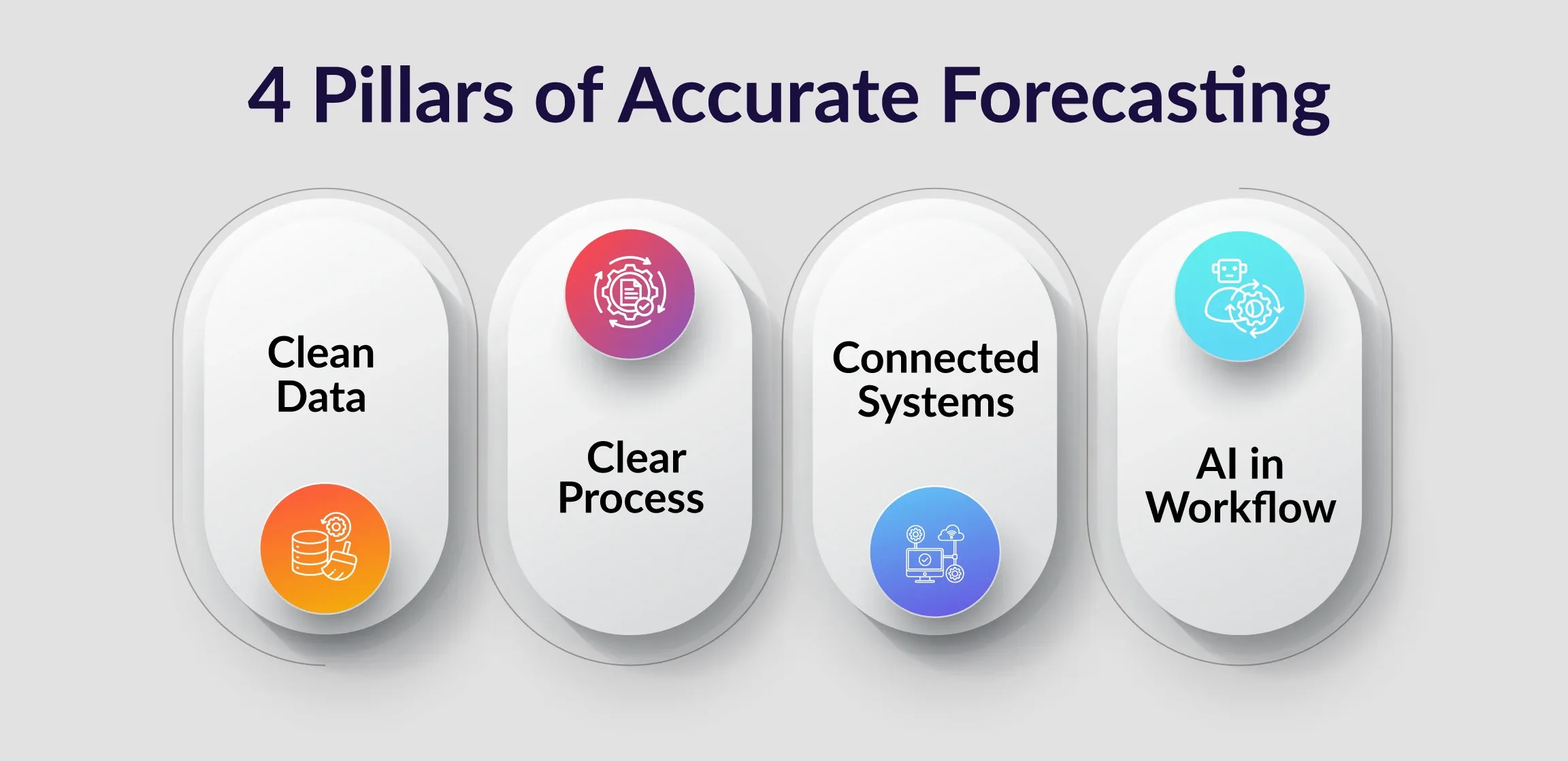
If AI alone isn’t improving your forecasts, then what actually will?
It comes down to getting the fundamentals right—so that everything you layer on top has a strong base to rely on.
1. It starts with clean, structured data
Your forecast is only as strong as the data behind it. That means consistent field usage, accurate close dates, realistic deal values, and a pipeline that reflects what’s actually happening—not what was true a few weeks ago. Without this, even the best AI models won’t produce meaningful outputs.
2. Then comes process discipline
Clear stage definitions, standardized forecasting categories, and consistent pipeline hygiene across teams. Everyone should be working with the same rules, not their own interpretation of them. This is what turns forecasting from a subjective exercise into a repeatable system.
3. Systems need to be connected
When CRM, marketing, and customer data live in silos, forecasting becomes fragmented. You miss critical signals—like engagement trends or expansion opportunities—that influence revenue outcomes. Bringing this data together creates a more complete and reliable picture.
4. And finally, AI has to be embedded into the workflow
Not added as a separate layer or dashboard that teams occasionally check. The real value comes when AI insights show up where decisions are being made—inside pipeline reviews, forecast calls, and daily workflows. That’s when it starts influencing behavior, not just reporting on it.
Get these pieces right, and AI starts to deliver on its promise.
Without them, it’s just another layer on top of a system that’s already struggling.
What Role Does RevOps Play in Forecast Accuracy?
This is where RevOps plays a critical role.
Because fixing forecasting accuracy in RevOps isn’t about choosing the right tool—it’s about designing the system those tools operate in.
RevOps sits at the center of that system. Between sales, marketing, and customer success. Between data, process, and technology. Which means it’s the function best positioned to make AI actually work in a meaningful way.
It starts with ownership of the fundamentals.
Defining how pipeline stages are used. Standardizing forecasting categories. Ensuring data is captured correctly and consistently. These aren’t one-time fixes—they require ongoing governance and accountability.
Then comes system design.
AI models don’t operate in isolation. They depend on how your CRM is structured, how data flows between systems, and how workflows are built. RevOps teams need to make sure everything is aligned—so AI isn’t just generating insights, but doing so on top of a reliable foundation.
And just as importantly, there’s adoption.
Even the best AI-driven insights won’t improve forecasts if teams don’t trust them or use them consistently. RevOps has to bridge that gap—making sure outputs are understandable, relevant, and embedded into how teams already work.
Because at the end of the day, AI doesn’t fix forecasting.
RevOps does. By building an environment where AI can actually add value.
What Are Common Forecasting Mistakes in RevOps?
Even with the right intent, a lot of RevOps teams end up going in the wrong direction when trying to improve forecasting with AI.
- One of the most common mistakes is
treating AI like a plug-and-play solution.
There’s an assumption that once the tool is in place, accuracy will improve automatically. But without fixing the underlying data and process issues, the output doesn’t change in any meaningful way. - Another is ignoring data quality
altogether.
Teams invest in advanced forecasting tools while their CRM still has inconsistent fields, outdated opportunities, or incomplete records. At that point, AI isn’t solving the problem—it’s just making it harder to spot. - Over-automation is another trap.
In an effort to remove manual effort, some teams rely too heavily on automated forecasts without enough human validation. That’s when context gets lost, and small issues turn into bigger misses. - There’s also a tendency to focus on tool
usage instead of actual outcomes.
Dashboards get built. Reports get shared. AI features get adopted. But the real question—are forecasts getting more accurate? often goes unanswered. - And finally, many teams underestimate the
importance of alignment.
If sales, marketing, and customer success aren’t working from the same definitions and expectations, forecasting will always be inconsistent—no matter how advanced the technology is.
These mistakes are easy to make, especially when the focus is on moving fast.
But avoiding them is what separates teams that experiment with AI from those that actually see results.
What This Means for Forecasting Accuracy
AI has changed what’s possible in forecasting—but it hasn’t changed what forecasting depends on.
If your data isn’t accurate, your process isn’t clear, or your teams aren’t on the same page, adding AI won’t fix the problem. It will just show the same issues more clearly.
That’s why improving forecast accuracy isn’t about adding more tools. It’s about getting the basics right first.
The teams that see real improvement aren’t the ones using the most advanced tools. They’re the ones with clean data, clear ways of working, and strong alignment across teams—and then they use AI to support that.
As the leading Salesforce AI consultancy, we help businesses build RevOps systems where data, process, and AI work together—so forecasting becomes more reliable, easier to act on, and built to grow with your business.
FAQs
AI can improve forecasting, but only when the underlying data and processes are reliable.
Because of poor data quality, inconsistent pipeline management, and lack of alignment across teams.
The biggest challenge is not tools—it’s maintaining accurate data and consistent processes.
The most effective approach combines both—AI for data insights and humans for context.