Quick Links
- What Do Enterprise Leaders Actually Mean by AI ROI?
- The Five ROI Questions Enterprise Leaders Are Asking Before Investing in AI
- Why Faster Validation Is Replacing Long AI Projects
- Which Enterprise AI Projects Deliver the Highest ROI?
- What Enterprise Leaders Are Doing Differently
- Why AI ROI Is Becoming the New Success Metric
- FAQs
Why Enterprises Are Prioritizing AI ROI Over Just AI Implementation

Key Takeaways
- Enterprise AI conversations are shifting from implementation to measurable business outcomes.
- Leaders now evaluate AI based on productivity, cost savings, revenue impact, and operational efficiency—not technical performance.
- Faster validation helps organizations prove business value before making larger AI investments.
- The highest-ROI AI initiatives solve practical business problems such as quoting, reporting, workflow automation, and contract intelligence.
- Successful enterprises prioritize business outcomes, governance, measurable KPIs, and connected AI strategies over simply deploying more AI tools.
One thing I've noticed in conversations with enterprise leaders is that AI discussions no longer begin with technology.
Instead, they begin with business value.
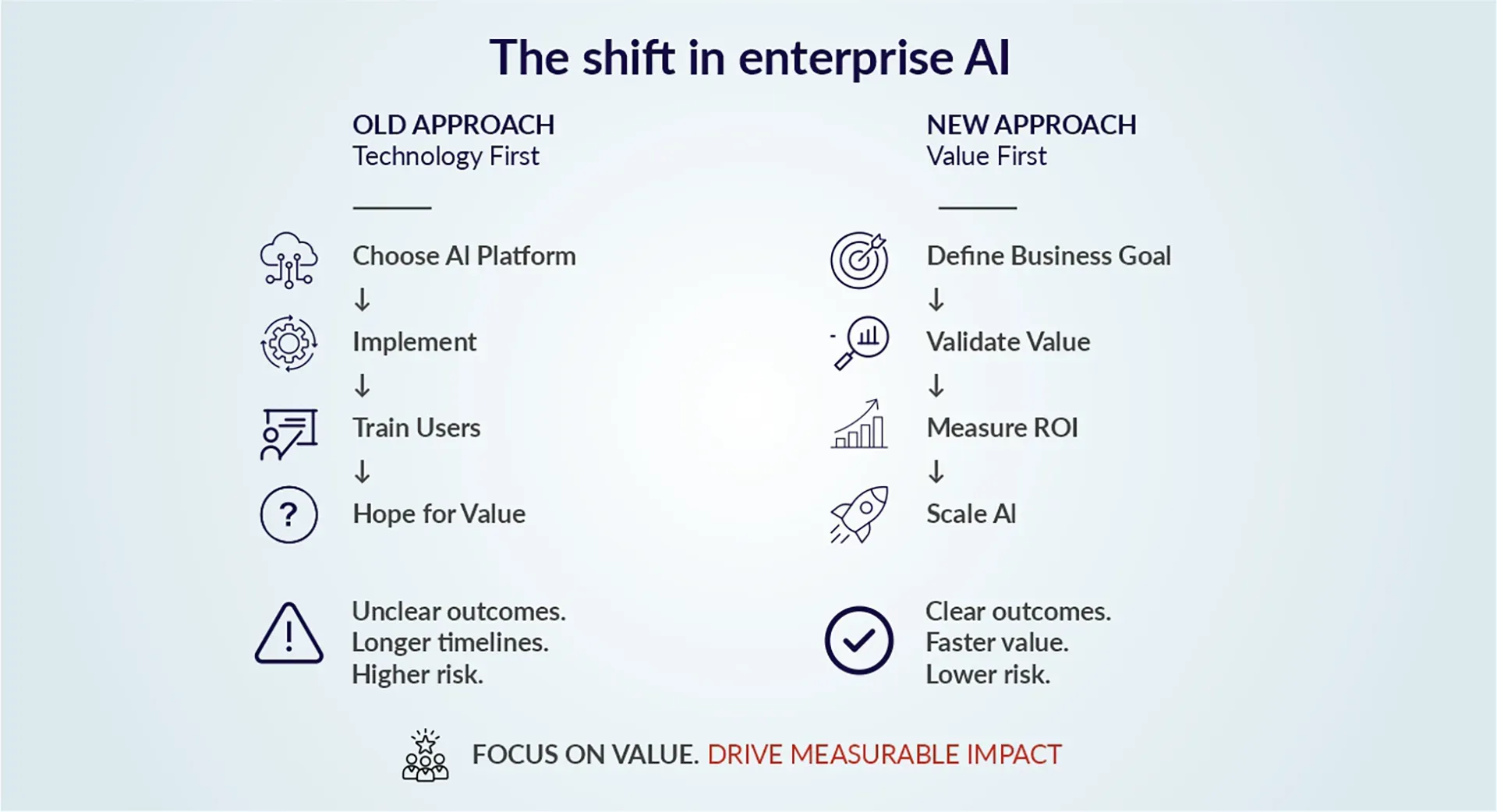
Not long ago, the first questions organizations asked were:
- Which AI platform should we use?
- How quickly can we implement it?
Today, those questions sound very different.
Enterprise leaders are asking:
- What business problem will this solve?
- How will we measure success?
- When will we see a return on our investment?
That shift says a lot about where enterprise AI stands today.
Across these conversations, I noticed that implementation is no longer viewed as the finish line. Most organizations already believe AI has the potential to improve the business. The real challenge is proving that it delivers measurable value once it's deployed.
Whether the discussion was about workflow automation, AI-powered dashboards, CPQ modernization, contract intelligence, or connected enterprise data, the conversation consistently came back to outcomes. Leaders wanted to understand how AI would improve productivity, reduce operational costs, accelerate decision-making, or create measurable business impact.
In other words, implementation has become the starting point.
ROI has become the real buying criterion.
That shift is changing how enterprises evaluate AI initiatives, prioritize investments, and decide which projects move forward. In this blog, I'll explore why enterprise leaders are placing greater emphasis on AI ROI, what they expect from AI investments today, and how that change is reshaping enterprise AI adoption.
What Do Enterprise Leaders Actually Mean by AI ROI?
When enterprise leaders talk about AI ROI, they're rarely referring to technical performance.
Across the conversations, very few discussions focused on model accuracy, response times, or benchmark scores. Instead, leaders evaluated AI based on the business outcomes it could deliver.
For most organizations, AI ROI means answering questions like:
Can we improve employee productivity?
Reduce repetitive work and give teams more time to focus on higher-value activities.
Can we make faster business decisions?
Surface insights quicker, shorten approval cycles, and reduce delays caused by manual processes.
Can we lower operational costs?
Automate routine workflows, reduce manual effort, and improve the efficiency of existing systems.
Can we accelerate revenue?
Help sales teams quote faster, improve forecasting, strengthen customer engagement, and shorten sales cycles.
Can we improve operational efficiency?
Connect data, streamline workflows, and help teams accomplish more with fewer handoffs.
These themes surfaced repeatedly across conversations involving AI-powered dashboards, CPQ modernization, workflow automation, contract intelligence, and enterprise reporting.
What stood out most was that enterprise leaders were measuring AI against business KPIs—not technical metrics.
Success was no longer defined by how accurate the model was.
It was defined by how much value the business gained from using it.
The Five ROI Questions Enterprise Leaders Are Asking Before Investing in AI
Across these conversations, I noticed that enterprise leaders weren't evaluating AI based on features alone. Instead, they were asking a consistent set of business-focused questions before deciding whether an AI initiative was worth pursuing.
1. Can this reduce manual work?
One of the biggest expectations from AI is eliminating repetitive, time-consuming tasks. Whether it's generating quotes, extracting contract information, or automating support requests, leaders want AI to free employees to focus on higher-value work.
2. Can it integrate with our existing systems?
AI creates the most value when it works with the systems employees already use. Leaders repeatedly emphasized the importance of integrating AI with platforms such as Salesforce, ERP systems, SharePoint, and other enterprise applications rather than introducing another disconnected tool.
3. Will employees actually use it?
Successful AI adoption depends on more than technology. Enterprise leaders are looking for solutions that are intuitive, fit naturally into existing workflows, and help employees work more efficiently without adding unnecessary complexity.
4. Can it scale across the business?
Many organizations have already experimented with AI. The next challenge is expanding successful use cases across teams while maintaining governance, security, and operational consistency.
5. Can we measure the outcome?
Ultimately, every AI investment comes back to business value. Leaders want clear evidence that AI improves productivity, reduces costs, accelerates decision-making, or contributes to revenue growth. If the outcome can't be measured, it's difficult to justify scaling the initiative.
These questions reflect a broader shift in enterprise AI adoption. Organizations are no longer investing in AI because it's innovative—they're investing because they expect measurable business results.
Why Faster Validation Is Replacing Long AI Projects
Another trend that surfaced repeatedly in conversations with enterprise leaders is the growing preference for validating AI quickly before making larger investments.
Rather than committing to lengthy implementation projects based on projected benefits, organizations increasingly want to see how AI performs against their own data, workflows, and business objectives.
This doesn't mean enterprises are avoiding AI implementation. It means they're looking to reduce risk by proving value early.
Several discussions highlighted how rapid prototypes and focused Proof of Value engagements are helping organizations validate specific use cases in days rather than months. By working with real enterprise data and clearly defined success criteria, leaders can determine whether an AI initiative is delivering meaningful business outcomes before deciding to scale it across the organization.
What stood out across these conversations was that faster validation changes the conversation. Instead of relying on assumptions or future projections, enterprise leaders can evaluate actual results—whether that's improved productivity, reduced manual effort, faster decision-making, or greater operational efficiency.
Ultimately, ROI can only be measured once value is validated.
That is why many enterprises are placing greater emphasis on rapid validation, measurable outcomes, and real-world business impact before making long-term AI investments.
Which Enterprise AI Projects Deliver the Highest ROI?
Across conversations with enterprise leaders, one pattern stood out clearly: the AI initiatives generating the strongest returns weren't necessarily the most advanced. They were the ones solving everyday operational challenges that affected productivity, efficiency, and decision-making.
Some of the highest-impact use cases included:
CPQ and Quote Automation
By helping sales teams generate accurate quotes faster and reducing manual approvals, AI shortens sales cycles, improves pricing consistency, and accelerates revenue generation.
AI-Powered Dashboards
Instead of manually compiling reports, leaders can access real-time operational insights through intelligent dashboards, enabling faster and more informed business decisions.
Workflow Automation
Automating repetitive business processes reduces manual effort, minimizes errors, and allows employees to focus on higher-value work across departments.
Contract Intelligence
AI can extract key information from contracts, surface compliance risks, and make enterprise documents easier to search, saving significant time while improving accuracy.
Help Desk Automation
AI-powered support assistants can resolve routine requests, reduce ticket volumes, and improve response times, allowing IT teams to concentrate on more complex issues.
Conversational Analytics
Rather than relying on technical teams to build reports, employees can ask questions in natural language and receive immediate insights, making enterprise data more accessible across the organization.
What these projects have in common is that their value can be measured. They reduce manual effort, improve operational visibility, accelerate business processes, and help organizations make better decisions using the data they already have.
That is why enterprise leaders are increasingly prioritizing AI initiatives with clear operational outcomes over projects that simply demonstrate technical capability.
What Enterprise Leaders Are Doing Differently
Across these conversations, one thing became increasingly clear: enterprise leaders are becoming more disciplined in how they approach AI investments.
Rather than evaluating AI based on features or implementation speed, they're focusing on measurable business value. That shift is changing enterprise priorities in several important ways.
| Instead of… | Enterprise leaders are prioritizing... |
|---|---|
| New AI tools | Business outcomes that improve productivity, reduce costs, and create measurable impact |
| Lengthy pilots | Faster validation with focused use cases and clearly defined success criteria |
| Standalone AI platforms | Unified AI strategies that connect existing systems and enterprise data |
| Governance after deployment | Governance from the start, with security, compliance, and risk management built into AI initiatives |
| Technology-focused metrics | Measurable KPIs such as operational efficiency, faster decision-making, employee productivity, and business outcomes |
These conversations reflect a broader shift in enterprise AI adoption. The organizations making the greatest progress aren't necessarily implementing more AI—they're implementing AI with a clearer purpose, stronger governance, and a sharper focus on return on investment.
Why AI ROI Is Becoming the New Success Metric
Across these conversations with enterprise leaders, one thing became clear: implementing AI is no longer enough. The real measure of success is the business value it delivers.
The organizations making the greatest progress with AI aren't necessarily implementing more AI. They're investing in initiatives that improve productivity, reduce costs, accelerate decision-making, and produce measurable outcomes.
As enterprise AI continues to mature, ROI is becoming the new success metric.
At Bolt Today, we've seen organizations achieve better results by validating business value early, aligning AI initiatives with measurable objectives, and scaling only after proving ROI.
If you're evaluating enterprise AI initiatives, we'd be happy to help identify high-impact opportunities and validate their business value before you invest at scale.
FAQs
AI ROI (Return on Investment) measures the business value generated by AI initiatives. It includes improvements in productivity, cost reduction, revenue growth, operational efficiency, and faster decision-making rather than technical performance alone.
Enterprise leaders typically measure AI ROI using business KPIs such as time saved, reduced manual effort, operational cost savings, faster sales cycles, improved customer experience, and increased employee productivity.
AI projects with the strongest ROI often include workflow automation, CPQ and quote automation, AI-powered dashboards, contract intelligence, help desk automation, and conversational analytics because they solve everyday operational challenges.
Organizations want to validate business value before making larger investments. By measuring outcomes early, they reduce risk, improve stakeholder confidence, and ensure AI initiatives support broader business objectives.