Quick Links
- What Does GTM Alignment Actually Look Like?
- Why GTM Alignment Breaks Down
- What Happens When GTM Metrics Are Misaligned?
- Why Do Metrics Matter for GTM Alignment?
- What Improves GTM Alignment Across Teams?
- What Role Does RevOps Play in GTM Alignment?
- What Are Common GTM Alignment Mistakes?
- What This Means for GTM Alignment?
- FAQs
Why GTM Alignment Fails: Are You Measuring Sales, Marketing, and Customer Success the Wrong Way?

Are your teams aligned—or just reporting different numbers?
If you’re leading RevOps or working across GTM, you’ve likely seen this play out. Sales is focused on closing deals and hitting targets. Marketing is driving campaigns and tracking leads. Customer Success is working on retention and customer growth.
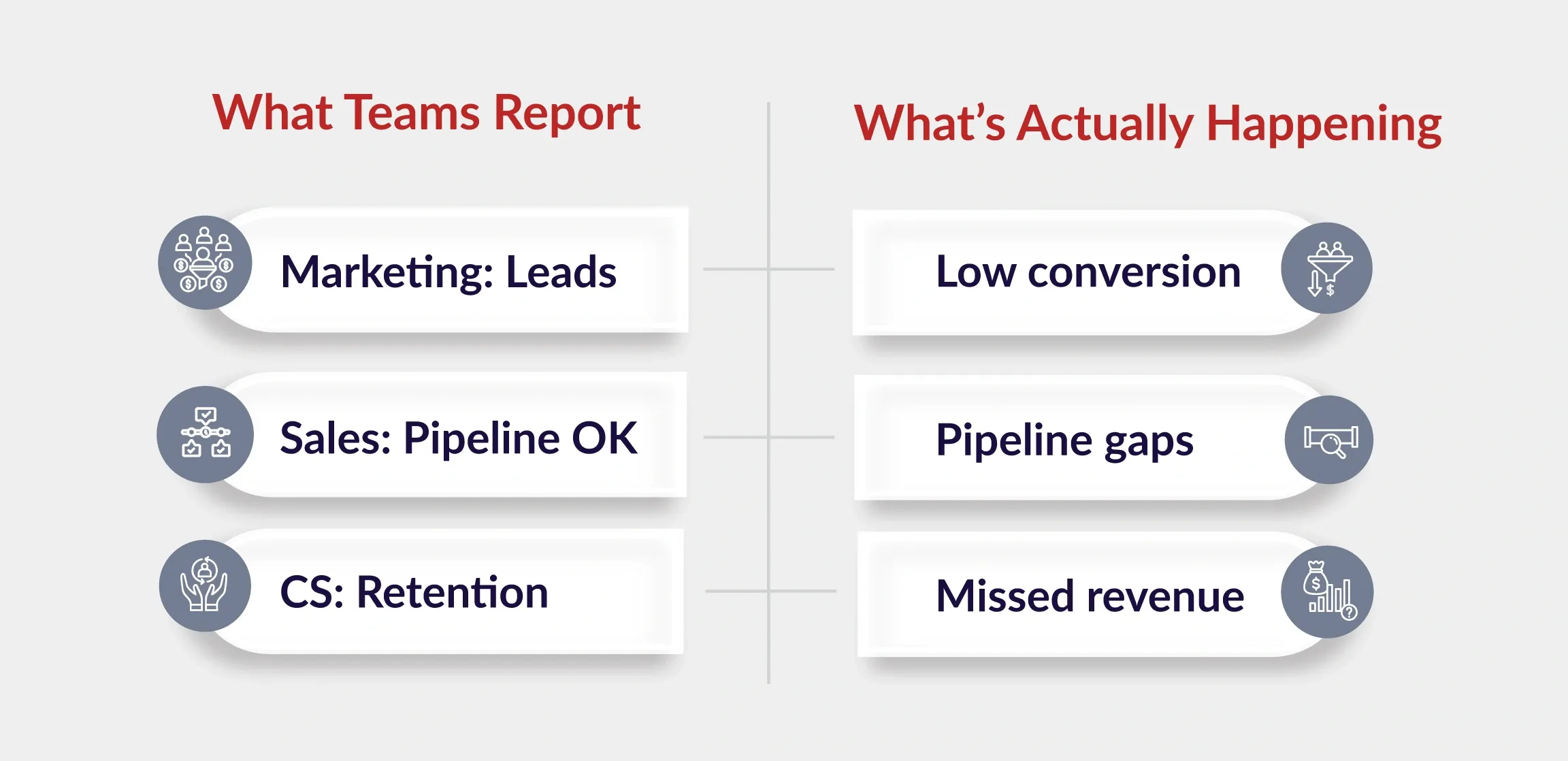
Individually, each team is doing what it’s supposed to do.
But when it comes time to look at performance together, things don’t always line up the way they should and that impact doesn’t always connect back to revenue conversations.
It’s not that any one team is wrong. It’s that they’re often working with different measures of success.
And over time, that creates small gaps—gaps in how performance is tracked, how results are interpreted, and how decisions are made.
That’s where alignment starts to break down.
Because GTM alignment is not only about teams working together. It depends on how success is defined and measured across the entire journey.
What Does GTM Alignment Actually Look Like?
So what does real GTM alignment actually look like?
At a basic level, it means Sales, Marketing, and Customer Success are working toward the same outcome—not just doing their own part well, but contributing to a shared goal.
That usually starts with revenue.
Instead of each team focusing only on its own targets, there’s a clear connection between activities and how they impact overall revenue. Marketing isn’t just generating leads, but contributing to pipeline quality. Sales isn’t just closing deals, but working with better context. Customer Success isn’t just retaining customers, but driving long-term value.
There’s also consistency in how things are defined.
What counts as a qualified lead? When does pipeline actually begin? What does a successful handoff look like? When these definitions are clear and shared, teams spend less time questioning the numbers and more time acting on them.
And just as importantly, there’s visibility across the full journey.
From the first interaction to renewal or expansion, everyone has a clear view of what’s happening. No gaps between teams, no missing context at handoffs.
When this kind of alignment is in place, decisions become easier. Conversations are more productive. And the focus shifts from defending numbers to improving outcomes.
Why GTM Alignment Breaks Down
If alignment is the goal, why does it break so often?
Because the way teams are measured pulls them in different directions.
1. First, teams are measured in silos.
Marketing focuses on leads and campaign performance. Sales focuses on closing deals. Customer Success focuses on retention and renewals. These metrics make sense individually, but they don’t always connect. Each team ends up optimizing for its own goals, even if that doesn’t help the overall outcome.
2. Then, metrics don’t reflect the full journey.
The customer journey doesn’t stop at a handoff—but the metrics often do. Marketing is measured until a lead is passed. Sales takes over until the deal closes. Customer Success owns what happens after. In between, important context gets lost, and no one fully owns the end-to-end experience.
3. And finally, success is defined differently across teams.
What counts as a “qualified” lead? When is a deal truly ready to close? What defines a successful expansion? If each team answers these questions differently, the numbers will never fully align.
Over time, these small differences add up.
And even when everyone is working hard, alignment starts to slip—not because of effort, but because the system they’re working in isn’t truly connected.
What Happens When GTM Metrics Are Misaligned?
When metrics aren’t aligned, the impact isn’t always obvious at first.
Each team still reports progress. Dashboards look active. Targets appear to be moving. But underneath, things start to drift.
One of the first signs is confusion.
Sales questions the quality of leads. Marketing questions conversion rates. Customer Success focuses on retention, but that story doesn’t always connect back to new revenue. Conversations start revolving around whose numbers are right instead of what’s actually working.
Then comes inefficiency.
Time gets spent fixing handoffs, rechecking data, or trying to understand where things went off track. Teams end up reacting instead of moving forward with clarity.
It also affects forecasting.
When metrics don’t connect across the journey, it becomes harder to predict outcomes with confidence. Pipeline may look strong, but conversion tells a different story. Retention might be improving, but it’s not reflected in growth plans.
And over time, it starts to affect the customer experience.
When teams aren’t aligned internally, the experience feels disconnected externally. Messaging shifts, expectations change, and handoffs don’t feel seamless.
These issues don’t usually come from lack of effort.
They come from measuring success in ways that don’t fully connect—making it harder for teams to move in the same direction, even when they intend to.
Why Do Metrics Matter for GTM Alignment?
So what happens when you fix how performance is measured?
Things start to come together.
Metrics don’t just track performance—they shape it. Teams focus on what they’re measured on. So when each team is measured differently, they naturally move in different directions. But when metrics are aligned, priorities start to align as well.
Marketing begins to look beyond just lead volume and focus more on quality and conversion. Sales works with better context and clearer expectations. Customer Success becomes a visible part of growth, not just retention.
It also changes how teams work together.
Conversations shift from defending numbers to understanding them. Instead of asking “who’s responsible,” teams start asking “what’s driving this outcome?” That shift makes collaboration more natural and more productive.
And over time, decisions get better.
With shared metrics, there’s a clearer picture of what’s working and what isn’t. Teams can adjust earlier, plan more confidently, and focus on improving results instead of reconciling data.
That’s why fixing metrics has such a big impact.
Because once everyone is measured in a way that connects, alignment doesn’t have to be forced—it starts to happen on its own.
What Improves GTM Alignment Across Teams?
If better alignment starts with better measurement, what does that look like in practice?
It starts with shifting the focus from isolated metrics to shared outcomes.
1. Shared, revenue-focused metrics
Instead of each team tracking success separately, there needs to be a clear link to revenue. Marketing looks at how leads convert into pipeline. Sales looks at how pipeline turns into closed deals. Customer Success looks at retention and expansion as part of overall growth. The metrics may differ, but they should all connect back to the same goal.
2. Clear and consistent definitions
Simple things make a big difference here. What qualifies as a lead? When does pipeline begin? What counts as expansion? When these definitions are shared, teams spend less time questioning the numbers and more time acting on them.
3. Visibility across the full journey
Everyone should be able to see how a customer moves from the first interaction through to renewal or growth. This reduces gaps during handoffs and helps teams understand how their work impacts the bigger picture.
4. Shared ownership, not just handoffs
Alignment improves when teams don’t see their role as “passing things along,” but as contributing to a continuous journey. That means staying connected to outcomes, even after a handoff.
These changes don’t require a complete overhaul.
But they do require a shift—from measuring individual performance in isolation to understanding how everything connects.
What Role Does RevOps Play in GTM Alignment?
This is where RevOps becomes essential.
Because aligning teams isn’t just about getting everyone in a room—it’s about creating a system where everyone is working from the same view.
RevOps sits at the center of that system. It connects sales, marketing, and customer success, and brings together the data, processes, and definitions that shape how performance is measured.
It starts with clarity.
Defining what each stage means, how metrics are calculated, and how performance is tracked across the journey. When these basics are clearly set, it removes a lot of confusion that teams deal with day to day.
Then comes consistency.
Making sure those definitions are followed across teams, not interpreted differently. This is what keeps reporting reliable and conversations aligned.
RevOps also plays a key role in how systems are set up.
From CRM to reporting tools, everything needs to reflect the same structure. If systems don’t match how teams actually work, alignment breaks quickly—even if the intent is right.
And just as important, there’s adoption.
Metrics only work when teams trust them and use them. RevOps helps bridge that gap—making sure reporting is clear, relevant, and part of everyday decisions.
Because in the end, alignment doesn’t happen on its own.
It needs to be designed, maintained, and continuously improved—and that’s exactly where RevOps adds the most value.
What Are Common GTM Alignment Mistakes?
Even with the right intent, it’s easy to fall into patterns that break alignment over time.
1. Focusing on isolated metrics
When each team tracks its own success without connecting it to the bigger picture, alignment naturally slips. Marketing may hit lead targets, sales may push for closures, and customer success may improve retention—but the outcomes don’t always connect.
2. Relying on volume over quality
Chasing higher numbers—more leads, more activities, more touchpoints—can look like progress. But if those numbers don’t translate into meaningful pipeline or revenue, they don’t help alignment.
3. Treating handoffs as endpoints
When teams see their role as “done” after passing something to the next team, important context gets lost. Alignment requires continuity, not just clean handoffs.
4. Overcomplicating reporting
More dashboards and more metrics don’t always mean more clarity. When reporting becomes too complex, teams spend more time understanding the numbers than acting on them.
5. Ignoring the post-sale journey
GTM alignment often focuses heavily on acquiring customers, while retention and growth are treated separately. This creates a gap between what’s sold and what’s sustained over time.
These mistakes don’t usually happen intentionally.
They build up gradually, especially as teams grow and metrics evolve. But addressing them is key to creating a more connected and effective GTM motion.
What This Means for GTM Alignment?
GTM alignment doesn’t usually fail because teams aren’t working hard enough.
It breaks when success is measured in ways that don’t connect.
When sales, marketing, and customer success are each working toward different metrics, even small gaps start to grow. Over time, those gaps show up in reporting, decision-making, and how teams work together.
The shift starts by rethinking what you measure.
Not by adding more metrics, but by making sure the ones you use actually reflect the full customer journey. When teams are measured in a way that connects—from first interaction to long-term growth—alignment becomes much easier to maintain.
That’s when things start to feel different.
Conversations become clearer. Decisions are based on a shared understanding. And teams move in the same direction, not because they’re told to—but because the system supports it.
As the leading Salesforce AI consultancy, we help businesses design GTM systems where data, metrics, and teams are aligned—so growth becomes more predictable and easier to scale.
FAQs
Because teams are measured differently and don’t share the same definition of success.
It means sales, marketing, and customer success work toward shared goals across the customer journey.
By aligning metrics, standardizing definitions, and connecting data across teams.
RevOps ensures consistent metrics, clear definitions, and connected systems across teams.