
Background
Why a 60-Day
Reset Was Needed
Background
A leading construction intelligence provider partnered with Bolt Today to modernize and stabilize its Salesforce ecosystem within an aggressive 60-day timeline. Years of growth, multiple integrations, legacy automation, and increasing data volumes had created operational inefficiencies, elevated technical debt, and growing risks across the CRM environment.
The organization needed a rapid transformation initiative to improve platform performance, strengthen governance, enhance sales productivity, and establish a scalable foundation for future innovation and AI-driven capabilities.
Challenge
Core Challenges Identified
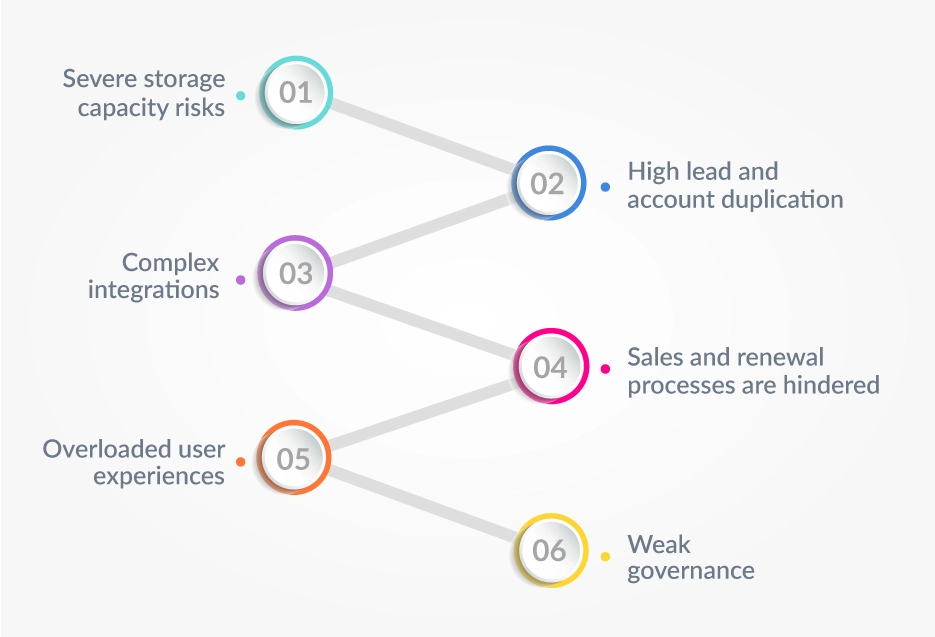
- Severe storage capacity risks caused by millions of historical activity records.
- High lead and account duplication resulting from multiple inbound sources and outdated matching rules.
- Complex integrations that increased deployment risk and slowed enhancement cycles.
- Sales and renewal processes impacted by legacy automation and inconsistent data structures.
- Overloaded user experiences reducing adoption and productivity.
- Lack of governance standards creating unpredictable change management processes.
Solution Delivered
A Fast, Structured, High-Impact Transformation
Bolt Today executed a sprint-based modernization program designed to deliver maximum impact within a strict 60-day timeframe. The initiative combined accelerated discovery, parallel execution, and focused stakeholder collaboration to address the organization's most critical Salesforce challenges.
The engagement was organized into six strategic workstreams:
- Conducted comprehensive storage analysis and consumption assessment.
- Designed and implemented a scalable archival strategy.
- Established retention policies for high-volume Salesforce objects.
- Deployed monitoring dashboards to proactively manage storage growth.
- Implemented governance standards for ongoing platform maintenance.
- Mapped duplicate patterns across multiple lead sources.
- Implemented enhanced matching and deduplication logic.
- Redesigned lead creation and ownership rules.
- Standardized merge processes and exception handling procedures.
- Improved overall data integrity across sales operations.
- Standardized ownership models across teams.
- Updated automation and reporting dependencies.
- Improved accountability and visibility for account management.
- Simplified ownership transitions and governance processes.
- Rebuilt routing processes to improve efficiency and transparency.
- Enhanced escalation, notification, and fallback mechanisms.
- Aligned workflows with business processes across sales and service teams.
- Introduced persona-based Lightning page layouts.
- Reduced interface clutter and consolidated permissions.
- Improved usability, navigation, and platform performance.
- Enhanced overall user adoption and productivity.
- Modernized dashboards and executive reporting.
- Standardized KPI definitions across departments.
- Implemented reporting governance and naming conventions.
- Improved visibility into operational and sales performance.
What began as a rapid modernization initiative resulted in a stronger data foundation, simplified operations, and a more efficient Salesforce experience across teams.
Business
Outcomes
- Reduced Salesforce storage risks through structured archival and retention strategies.
- Simplified platform administration and ongoing maintenance.
- Improved system performance and user experience.
- Reduced operational risks associated with legacy processes and integrations.
- Significantly reduced duplicate records.
- Strengthened data governance and ownership controls.
- Increased confidence in reporting and business decision-making.
- Streamlined lead management and ownership processes.
- Improved routing efficiency and response times.
- Simplified user workflows, enabling teams to focus on revenue-generating activities.
- Enhanced visibility into pipeline and customer engagement metrics.
- Established a sustainable governance framework.
- Standardized metadata, naming conventions, and operational processes.
- Created a scalable foundation for future Salesforce enhancements.
- Improved readiness for AI-powered insights and automation initiatives.

The Result
At the end of the 60-day engagement, the organization successfully transformed its Salesforce environment from a complex, high-risk ecosystem into a streamlined, governed, and scalable platform.
With improved data quality, optimized workflows, stronger governance, and enhanced user experiences, the company is now positioned to support future growth, accelerate business operations, and confidently pursue AI-driven innovation initiatives.