
Background
When Growth
Outpaced the
System
Background
After consolidating three legacy organizations into a single Salesforce environment, a rapidly expanding industrial services provider engaged Bolt Today to modernize and optimize their Salesforce platform. While this merger established a scalable foundation, it also introduced substantial technical debt, inconsistent procedures, and adoption issues that hindered sales activities and quoting processes.
While Salesforce should serve as the company’s main revenue engine, users often experienced friction: quoting took weeks, data structures were inconsistent, automations were outdated, and multiple business units were not aligned on a unified lead-to-cash lifecycle.
The client collaborated with Bolt Today to implement a phased approach, starting with immediate stabilization and progressing toward long-term transformation.
Challenge / Opportunity
Core Challenges Identified
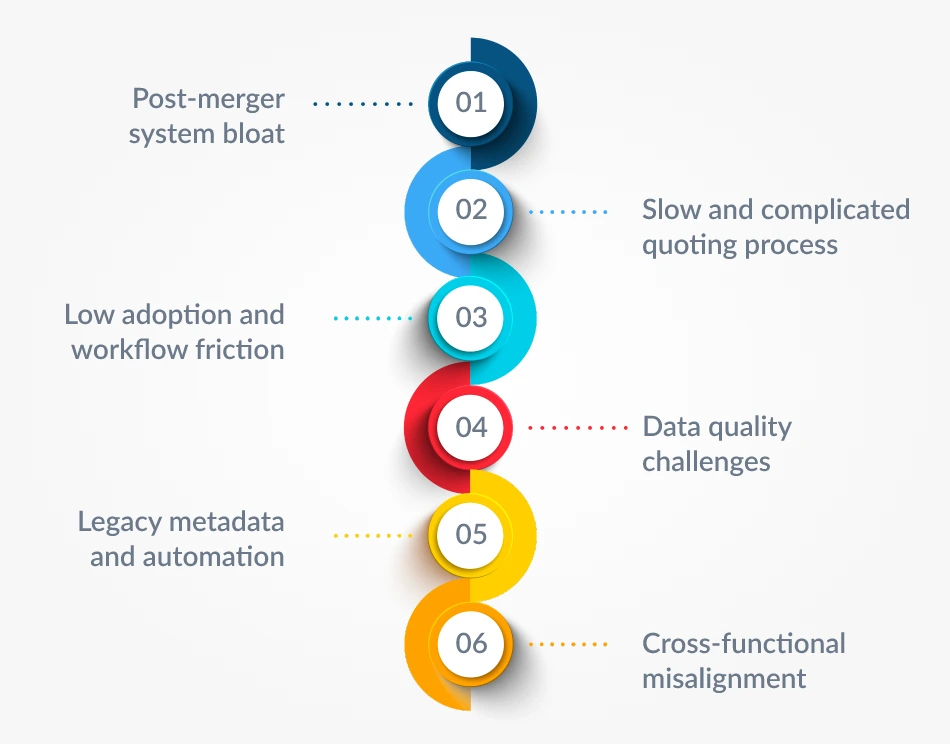
- Post-merger system bloat: three merged organizations resulted in duplicate objects, unused fields, and inconsistent record types.
- Slow and complicated quoting process: pricing rules, Excel-based bid sheets, and outdated CPQ customizations lengthened cycles to weeks
- Low adoption and workflow friction: cluttered screens, too many clicks, and poorly aligned page layouts made the system feel like a “micromanagement tool.”
- Data quality challenges: duplicate leads and accounts, inconsistent naming conventions, and incorrect search results.
- Legacy metadata and automation: workflows and process builders not yet migrated to flows; technical debt across the organization.
- Cross-functional misalignment: inconsistent handoffs across Marketing, Sales, Operations, and Finance.

The Opportunity
Implement a phased strategy that achieves quick wins within the first 8–10 weeks, then focuses on thorough optimization of the CPQ process and the complete lead-to-cash cycle.
The strategic goal: transform Salesforce into a scalable, predictable, data-driven revenue system.
Our Approach
Bolt Today designed a 3-phase transformation program:
- Lead-to-opportunity management redesign
- UX simplification & layout rationalization
- Cleanup of fields, record types, and objects
- SLA-driven lead flow automation
- Permission & security tightening
- Quick performance & adoption gains
- CPQ friction removal (rules, templates, approvals, Excel imports)
- MQL → SQL handoff formalization
- De-duplication and data cleanup
- Standardization across divisions
- Cross-functional discovery (Sales, Ops, Finance)
- Roadmap for CPQ modernization
- Evaluate next-gen quoting platforms (Revenue Cloud, DealHub, etc.)
- Guided selling
- Renewals & amendments
- ERP/Compliance/Legal integrations
- Advanced analytics & AI pilots
- Enterprise-change management
Bolt Today designed a three phase transformation program to transform Salesforce into a scalable, predictable and data-driven revenue system.
What We Have
Built So Far
- Full metadata + configuration audit
- CPQ configuration scan
- Duplicate analysis (Accounts, Leads, Contacts)
- Page layout & Lightning performance assessment
- Technical debt register created
Sessions with Sales, Sales Ops, CPQ, and Operations to map friction, uncover hidden dependencies, and align on priorities.
- Reduction of page clutter
- Field consolidation plan
- Role-based UX design
- Data cleanup strategy
- Early CPQ friction fixes
Current
Focus
- Reduce and consolidate record types
- Clean up unused fields and metadata
- Migrate legacy automation to Flows
- Standardize picklists and global value sets
- Clean up Accounts & Opportunities screens
- Improve CPQ performance (rules, logic, load time)
- Permission-set redesign
- Reorganizing Lightning pages
- Reducing page load time for CPQ and Opps
- Removing duplicates across key objects
- Updating security posture
- Preparing naming standards and governance
What's Ahead
(Aligned with the SOW timeline from Dec 2025 → March 2026)
Next 30–40 Days
- Complete CPQ performance uplift
- Launch simplified layouts for user groups
- Deploy key automation fixes
- Finalize dedupe across core objects
- Finalize and deploy optimization work items
Final Sprint to Completion
- ROI Scorecard & Financial Impact Model
- 30/60/90-Day Plan for post-project improvements
- 6–12 Month CPQ modernization roadmap
- Technology recommendation (optimize vs. rebuild vs. replace)
Expected
Business
Impact
- Predictable pipeline with cleaner data
- Measurably shorter quote cycles
- SLA-driven lead follow-up
- Consistent reporting across business units
- Lower system risk and stronger governance
- Faster page loads with fewer distractions
- Fewer fields to fill out; less manual entry
- Clearer and more reliable search results
- More reliable quoting and fewer Excel-based failures
- 20–40% reduction in field count on key objects
- 60–80% reduction in duplicate records
- Weeks → days improvement in quote throughput
- Increased adoption based on activity logging
- Fewer support tickets for CPQ/data issues