
Executive Summary
Executive Summary
Salesforce transformations increasingly fail not due to strategy but due to fragile org foundations and misaligned business processes. As Salesforce estates scale, technical complexity and business process drift accumulate, creating hidden risk, rising cost, and poor transformation ROI.
Bolt’s Salesforce Org Technology & Business Function Assessment delivers a comprehensive, AI-driven diagnosis of both:
- Technical platform health, and
- End-to-end business function effectiveness (Sales, Service, Operations, Revenue)
The outcome is a customer-priority-aligned, 6-month execution roadmap that stabilizes the org, optimizes cost and performance, and scales governance—creating a clean, resilient Salesforce foundation for future transformation programs such as AI, CPQ, M&A, ERP, and Data Cloud.
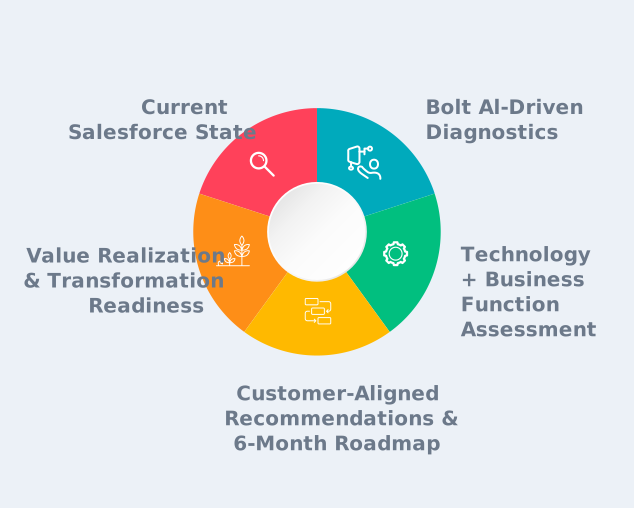
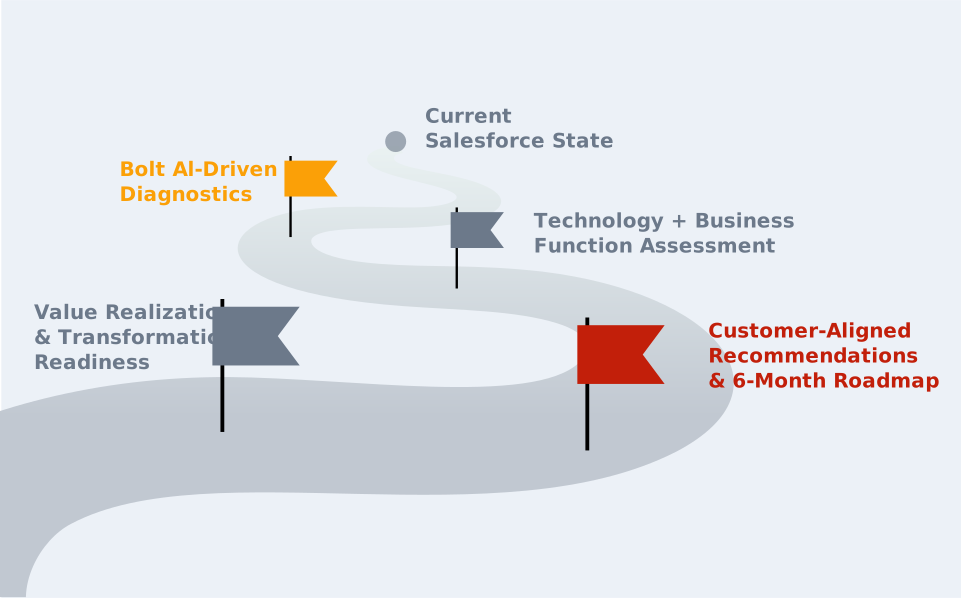
Salesforce Transformation Steps
- Current Salesforce State
Icons represent automation sprawl, technical debt, process misalignment, and security risk. - Bolt Al-Driven Diagnostics
Tool icons for Sweep.io, Salesforce Org Check, and Al-driven Process Mining. - Technology + Business Function Assessment
Split view showing technical and business assessments. - Customer-Aligned Recommendations & 6-Month
Roadmap
Stabilize, optimize, and scale over six months. - Value Realization & Transformation Readiness
Outcomes include reduced risk, lower TCO, faster ROI, and Al-ready Salesforce.
Salesforce Transformation Steps
Engagement
| Dimension | Details |
|---|---|
| Salesforce orgs assessed | 4 |
| Company profile | Mid-market to enterprise |
| Active users | 500–5,000+ |
| Custom objects | 300–1,200 |
| Automation artifacts | 400–1,500+ |
| Business functions assessed | Sales, Service, RevOps, Ops |
| Assessment delivery | 10–15 business days |
| End-to-end execution | ≤ 6 months |
Business
Context &
Transformation
Trigger
Organizations engaged Bolt before launching major transformation programs, driven by the realization that:
“Transforming Salesforce without stabilizing the org and validating business processes significantly increases cost, risk, and time-to-value.”
Typical triggers included:
- AI / Einstein / GenAI enablement
- CPQ or pricing transformation
- Revenue operations realignment
- ERP, Data Cloud, or marketing integrations
- M&A-driven org consolidation
- Security, audit, or compliance mandates
The
Core Problem
(Pre-Assessment
Reality)
Across all assessed orgs, Bolt identified both technical and business-level issues that directly undermine transformation success.
- Parallel automation engines (Flows, Triggers, legacy workflows)
- No deterministic execution order
- Limited fault handling and observability
- Salesforce workflows not aligned to actual sales, service, or operational processes
- Over-automation of low-value steps and under-automation of critical ones
- Manual workarounds masking systemic issues
- Low Apex test coverage blocking CI/CD
- High dependency chains preventing safe refactoring
- Limited confidence in making large-scale changes
- 30–45% unused fields and layouts
- Over-licensed and over-privileged users
- Inconsistent access governance and audit controls
What Bolt
Assessed
(Technology +
Business Functions)
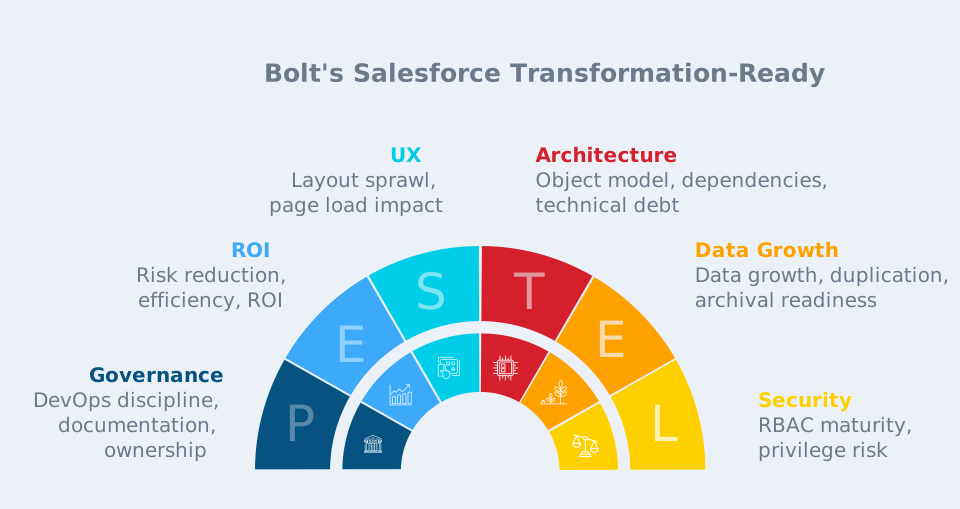
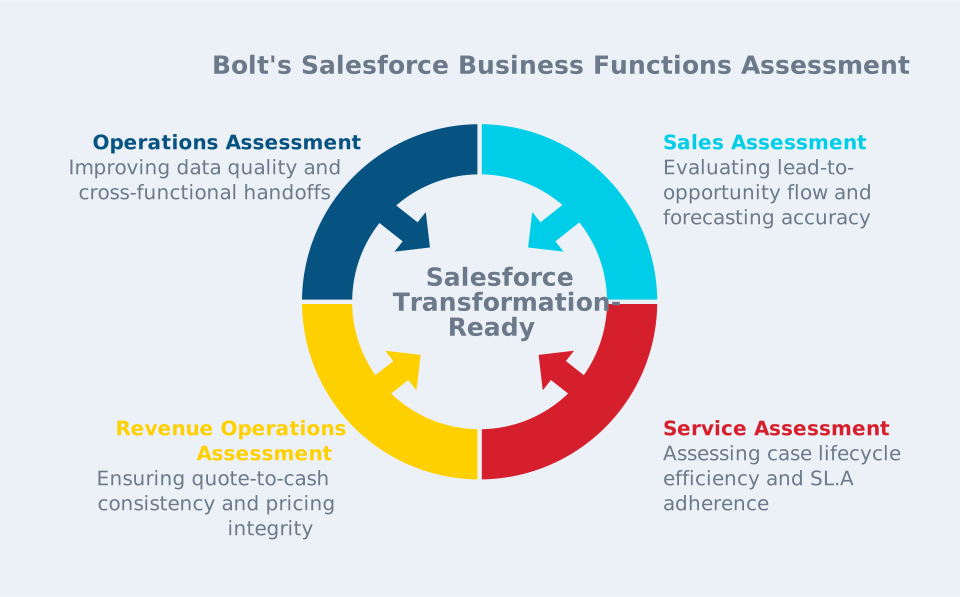
Bolt’s assessment scope intentionally covers both Salesforce technology AND the business functions it enables.
Technical
Org Assessment

Technical
Org Assessment
| Area | Focus |
|---|---|
| Architecture & Complexity | Object model, dependencies, tech debt |
| Automation Landscape | Flow/Trigger conflicts, recursion risk |
| Code Quality | Apex volume, test coverage, API versions |
| Data & Storage | Growth, duplication, archival readiness |
| Security & Access | RBAC maturity, privilege risk |
| Integrations | API usage, failure points |
| UX & Performance | Layout sprawl, page load impact |
| Governance | DevOps, documentation, ownership |
Business
Function Assessment

Business
Function Assessment
| Function | Key Validation Areas |
|---|---|
| Sales | Lead-to-opportunity flow, forecasting accuracy |
| Service | Case lifecycle efficiency, SLA adherence |
| RevOps | Quote-to-cash consistency, pricing integrity |
| Operations | Data quality, cross-functional handoffs |
Outcome:
How
Bolt Delivered
(AI + Tools +
Consulting
Expertise)
Bolt’s approach combines AI-driven diagnostics, enterprise-grade tools & deep consulting expertise.
Tool-Based & AI-Driven Diagnostics
A. Sweep.io
- Automation execution mapping
- Redundant logic identification
- Metadata usage correlation
B. Salesforce Org Check
- Configuration hygiene scoring
- Best-practice alignment
C. AI-driven process mining
- Business workflow validation
- Identification of bottlenecks, rework, and inefficiencies
- Correlation between system behavior and business outcomes
Expert Validation & Advisory
A. Senior Salesforce architects validate AI findings
B. Business consultants align insights to customer priorities
C. Recommendations framed in risk, ROI, and transformation readiness
Findings → Diagnostics →
Recommendations → Value Realization
Bolt follows a structured value realization model.
Typical
Findings
(Aggregated)
| Metric | Observed Range |
|---|---|
| Automation artifacts | 600–1,500+ |
| Redundant automations | 40–60% |
| Low/no-usage fields | 30–45% |
| Apex test coverage | 5–15% (low baseline) |
| Over-privileged users | 25–40% |
Diagnostics
- Automation conflict probability: 40–60%
- Storage capacity risk within 12–18 months
- Business workflows deviating from intended process models
Recommendations
- Always aligned to customer priorities:
- Revenue protection
- Cost optimization
- Compliance
- Transformation timelines
Deliverables to
Leadership (With
ROI Impact)
| Deliverable | Business Value / ROI |
|---|---|
| Executive Org Health Summary | Clear visibility into enterprise risk |
| Technical & Business RAG Scorecard | Confident prioritization and funding |
| Business Risk & Cost Analysis | Quantified savings and exposure |
| Process Optimization Recommendations | Improved productivity & cycle times |
| Customer-Aligned 6-Month Roadmap | Predictable, low-risk execution |
| Sr. No. | Focused Area | Status (RYG) | Bulleted Justification (Facts, Metrics, Evidence) |
|---|---|---|---|
| 1 | Platform Stability & Automation Health | Red |
|
| 2 | Metadata & Configuration Hygiene | Red |
|
| 3 | Business Controls, Security & Compliance | Red |
|
| 4 | Governance Maturity & Org Discipline | Red |
|
| 5 | Data Quality & Integrity | Yellow |
|
| 6 | Overall Architecture & Integration Readiness | Yellow |
|
Optimization & Implementation (Bolt-Led)
Unlike traditional assessments, Bolt supports optimization and implementation to ensure value realization.
6-Month Execution Model
Phase
Stabilize
Timeline
Month 0–2
Outcome
Reduced failures, security hardening
Phase
Optimize
Timeline
Month 2–4
Outcome
Lower TCO, improved performance
Phase
Scale
Timeline
Month 4–6
Outcome
Governance, AI readiness
Business Value
Proposition and
Impact Metrics
(Observed
Ranges)
Executives consistently acknowledged the assessment’s value due to its direct impact on operational performance, risk posture, and future scalability.
Red automation, near-zero test coverage, and unregulated API calls posed real risks. The assessment eliminated hidden failure points that could halt operations.
Identified 10–20% annual savings through license rationalization and unused assets.
Cleaning duplicates, field bloat, and inconsistent definitions restored trust in dashboards, forecasts, and compliance reporting.
By stabilizing the architecture, clients could finally move ahead with CPQ, integrations, and customer experience projects.
CXOs understood the importance of repeatable processes, which this assessment enabled through a governance roadmap.
A clean, well-governed Salesforce org becomes a foundation for Einstein, GPT, and generative automation.
| Area | Improvement |
|---|---|
| Automation footprint | ↓ 45–65% |
| Storage reclaimed | 25–40% |
| Deployment failures | ↓ 40–60% |
| License cost optimization | 10–20% |
| UX performance | ↑ 20–30% |
| Duplicate data | ↓ 60–75% |
| Admin & support effort | ↓ 20–30% |
Transformation Enablement
- Significantly reduced risk for AI, CPQ, ERP, and M&A programs.
- Faster time-to-value for transformation initiatives.
- Sustainable governance preventing regression.
The Bolt Today
Differentiator
Our assessment is not a “scan + checklist.”
It is a blueprint-level,
architecture-led deep dive.
Our expertise in Sweep, OrgCheck, and Architect analysis offers insights beyond the scope of typical consultancies’ efforts.
We now have a deep data foundation across four companies and counting — allowing customers to see how they compare to peer orgs.
The outputs are not of an academic nature.
They provide clear
guidance on implementation, sequencing, and budgeting.
Thanks to automation and internal tools, we provide assessments rapidly while maintaining their thoroughness.